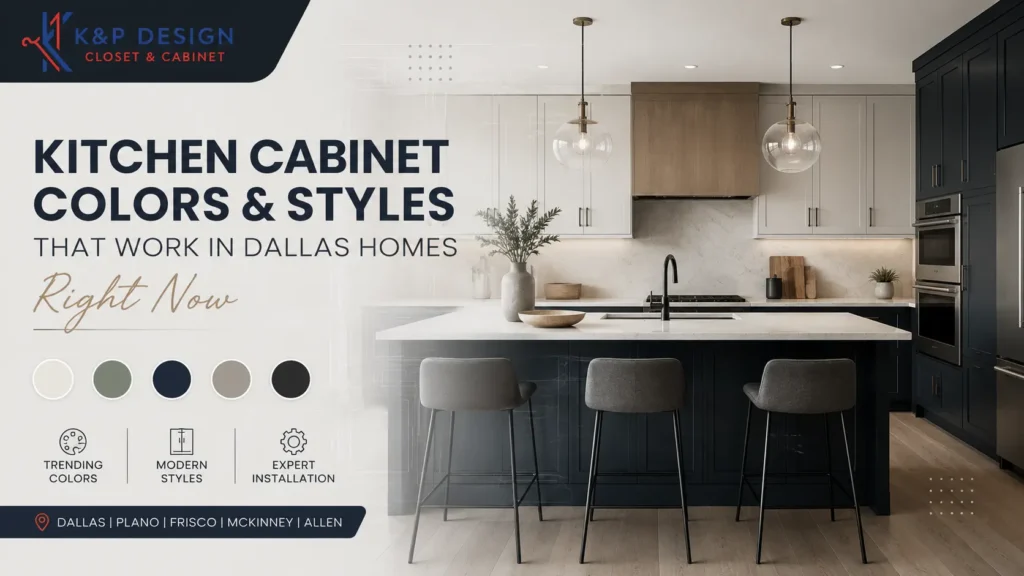
Cabinet shopping is one of those things where having too many options makes the decision harder, not easier. You look at a thousand photos on Pinterest, collect thirty paint chips, and end up more confused than when you started.
Most of those photos are from California or New York or the Pacific Northwest. They reflect local design trends, local light conditions, and local housing stock. What looks incredible in a bright, west-facing San Francisco kitchen can look flat and dark in a north-facing Dallas ranch house.
This guide is specifically about kitchen cabinets in Dallas homes — the colors that work with Texas light, the styles that suit the actual housing stock here, and the choices that hold up over time. KP Closet and Cabinet Design has worked on kitchens across Dallas, Plano, Frisco, McKinney, Allen, and the surrounding suburbs.
Table of Contents
- The Colors That Actually Sell in Dallas Right Now
- Two-Tone Cabinets: Worth It or Just a Trend?
- Wood Stains vs. Paint: A Practical Comparison
- Cabinet Hardware: The Detail That Ties Everything Together
- Upper vs. Lower Cabinet Decisions
- Open Shelving: Honest Pros and Cons
- Kitchen Cabinet Installation in Dallas: What the Process Looks Like
- How to Make a Small Dallas Kitchen Feel Bigger
- Matching Cabinets to Your Dallas Home Style
- FAQs
The Colors That Actually Sell in Dallas Right Now
Color trends in kitchens move slower than people think. A color that feels fresh today will still look relevant in eight years if it is a solid, classic choice. For a broader look at what’s trending this year, see our guide to kitchen cabinet trends in 2026.
White and Off-White
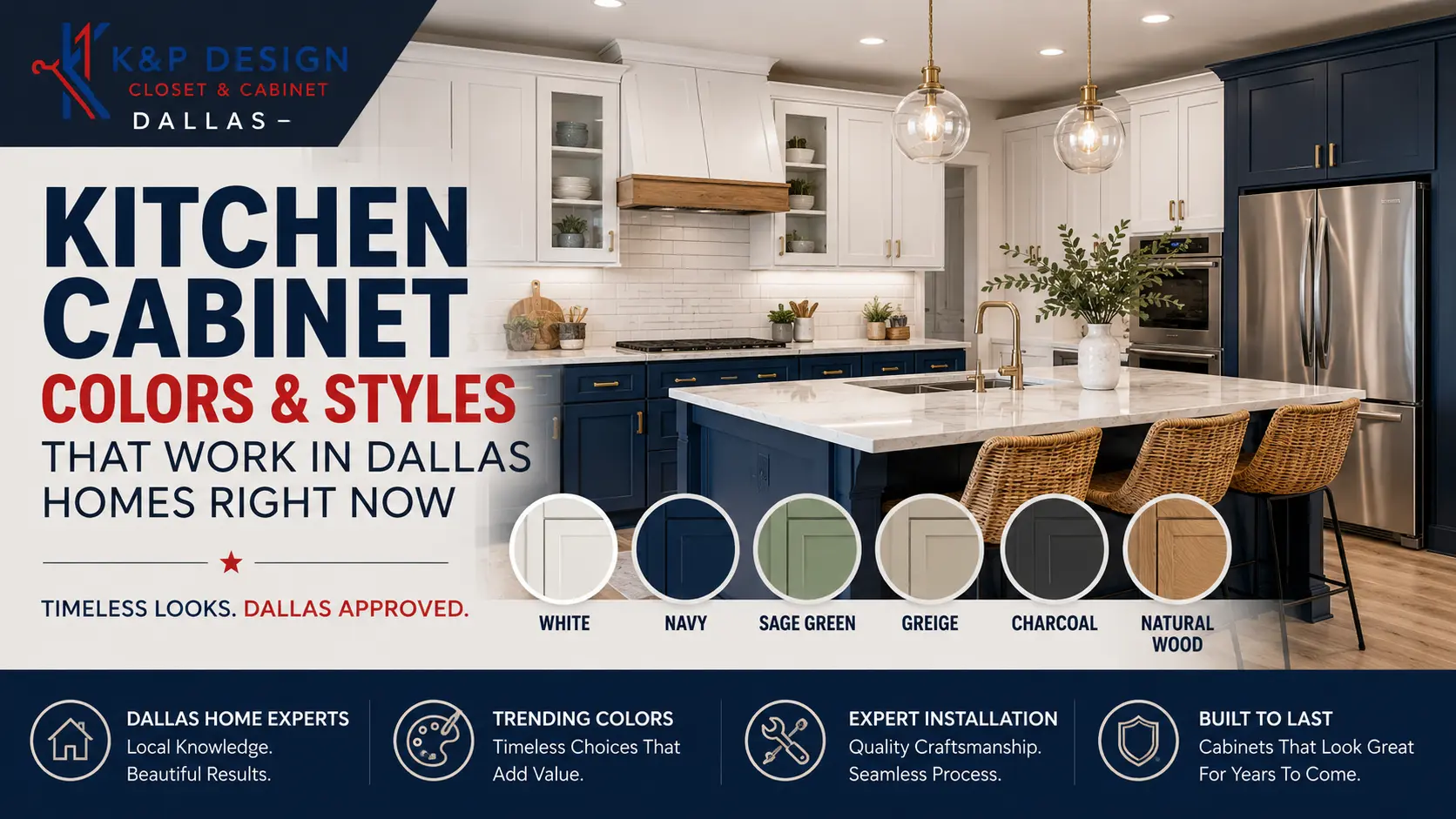
White kitchen cabinets have been popular for a long time, and they are not going anywhere. The reason is practical: white reflects light, which makes kitchens feel larger and brighter. In Dallas homes where the kitchen faces north or gets limited natural light, white cabinets do real work. The range within white is wide — true bright white reads as modern and clean, creamy whites like Swiss Coffee or Chantilly Lace feel softer and warmer, and greige-white hybrids like Accessible Beige work well in transitional kitchens.
Navy and Deep Blue
Navy cabinets became mainstream in Dallas around 2019 and have not faded since. Deep blue pairs naturally with warm wood tones, brass hardware, and white or light gray countertops. In larger kitchens with good light, navy base cabinets with white uppers is a combination that photographs well and looks better in person. Be careful with navy in smaller kitchens without good natural light — a dark color in a small space can feel compressed.
Sage Green
Sage green has found a receptive audience in Dallas. It reads as calm and slightly organic, which is appealing in kitchens. Sage green works particularly well in transitional homes and pairs naturally with natural wood elements.
Greige (Gray-Beige)
Greige is the neutral that unseated gray over the last few years. True cool gray has started to date in Dallas interiors, while warm greige reads as current and versatile. Greige works in almost every home style and complements both warm and cool countertop materials.
Charcoal and Black
Charcoal and near-black cabinets are not for everyone, but in the right kitchen they are striking. A full charcoal kitchen needs strong light and at least one contrasting element: light countertops, open windows, or light-colored flooring. KP Closet and Cabinet Design has completed several charcoal kitchen installs in newer Dallas homes where the results were genuinely excellent.
Two-Tone Cabinets: Worth It or Just a Trend?
Two-tone cabinets — where the upper and lower cabinets are different colors — have been popular for long enough that they have stopped being a trend and started being a legitimate design approach. The most common version in Dallas kitchens is white uppers with a colored lower cabinet: navy, sage, greige, or charcoal. This keeps the kitchen feeling open at eye level while adding depth and character at the base.
A less common but equally effective version uses natural wood lowers with painted uppers. Two-tone does add a layer of complexity and cost, but for a kitchen where you want more personality without committing fully to a bold color everywhere, it is a practical approach. The one version to be careful about: two-tone where neither color is particularly strong on its own — if both choices are timid, the combination ends up looking accidental rather than intentional.
Wood Stains vs. Paint: A Practical Comparison
This is one of the most common questions in kitchen design. For a deep dive into the materials themselves, read our guide to solid wood vs. MDF vs. plywood cabinets in Dallas.
Stained cabinets show the wood grain, giving them warmth and natural variation. Stained wood finishes age gracefully — they do not show wear as obviously as paint, and they can be refinished when the color starts to look dated. They commit you to a warm, natural palette that works beautifully with stone countertops, warm flooring, and traditional or transitional design schemes.
Painted cabinets offer more color control and a cleaner look. They photograph well, which matters if you are planning to sell the home. The practical downside is that chips and scratches are more visible on painted surfaces, especially on lower cabinets and around hardware where daily use takes a toll.
In Dallas, both approaches are popular and both work well when executed correctly. The choice comes down to the aesthetic you want and how much maintenance you are willing to do over the life of the kitchen.
Cabinet Hardware: The Detail That Ties Everything Together
Hardware is the jewelry of the kitchen, and the wrong choice reads immediately.
Brass and Gold
Warm metallic hardware — brass, brushed gold, and unlacquered brass — has dominated kitchen design for several years and continues to hold strong. It pairs well with white, navy, sage, and warm wood finishes. Brushed brass is more forgiving in terms of fingerprints and wear than polished brass.
Matte Black
Matte black hardware is still a strong choice in modern and industrial kitchens. It pairs best with white, gray, or charcoal cabinets but shows fingerprints more than most people expect in a busy kitchen.
Brushed Nickel and Chrome
These are the classic choices and they have not gone out of style. In transitional and contemporary kitchens, brushed nickel reads as clean and timeless, and coordinates easily with stainless appliances.
Size and Placement
Pulls on lower cabinets look proportional at five to six inches. Upper cabinet pulls typically run three to four inches. One rule that holds consistently: keep hardware finish consistent throughout the kitchen. Mixing metals can work, but for most homeowners, one finish throughout is the cleaner choice.
Upper vs. Lower Cabinet Decisions
Full upper cabinets give you maximum storage, but a wall of upper cabinets can feel heavy, especially in a kitchen with lower ceilings. Some Dallas homeowners are choosing to run upper cabinets to the ceiling on one wall while keeping another wall more open with floating shelves or a single row of shorter cabinets. Glass-front upper cabinets are another option that breaks up the visual weight. Upper cabinet decisions should be driven by storage needs first and aesthetics second. For a full breakdown of smart storage decisions, see our guide to choosing kitchen cabinets in Dallas.
Open Shelving: Honest Pros and Cons
The case for open shelving: It makes the kitchen feel more open and airy. It can display items you genuinely like — ceramics, cookbooks — in a way that feels curated rather than cluttered.
The case against it: Dallas is a dusty city. Open shelves collect dust, grease, and particulate matter from cooking. Everything on those shelves needs to be washed more frequently than cabinet-stored items. If you are not the kind of person who reorganizes and cleans regularly, open shelving will look chaotic within six months.
The most practical approach: use open shelving in one section of the kitchen and keep the rest as closed cabinets. You get the visual benefit without committing your entire storage system to an approach that requires ongoing maintenance.
Kitchen Cabinet Installation in Dallas: What the Process Looks Like
Kitchen cabinet installation in Dallas follows a fairly standard sequence, but the quality of execution varies significantly between companies.
- Demolition: Existing cabinets are removed. Plumbing and electrical work behind the cabinets is completed at this stage.
- Wall preparation: Walls are patched, primed, and sometimes painted before cabinets go in.
- Layout and leveling: The most critical step. A professional installer marks stud locations, determines the high point of the floor, and establishes the level lines everything else is built from. A kitchen that is out of level will have gaps, misaligned doors, and drawers that do not close properly.
- Upper cabinet installation: Upper cabinets go in before lower cabinets. Each cabinet is screwed into studs, and adjacent cabinets are screwed to each other to create a rigid run.
- Lower cabinet installation: Base cabinets are shimmed and leveled to a consistent height. Where the floor is uneven — common in older Dallas homes — shims bring everything to the same plane.
- Doors, drawers, and hardware: Doors and drawer fronts are hung and adjusted. Soft-close hinges and drawer slides are installed and tuned.
- Trim and molding: Crown molding, light rail, and toe kicks complete the installation. This is the stage that separates a professional result from an amateur one.
KP Closet and Cabinet Design handles kitchen cabinet installation in Dallas as a complete service, with experience across the full range of Dallas housing — from new construction in the northern suburbs to older homes in the urban core where walls are rarely perfectly plumb and floors are rarely perfectly level.
How to Make a Small Dallas Kitchen Feel Bigger
Plenty of homes in East Dallas, Oak Cliff, Lakewood, and older parts of Plano have kitchens built when open layouts were not the standard. If you are working with a smaller kitchen, cabinet choices matter more, not less.
- Lighter colors: Light cabinet colors reflect more light and make a space feel larger. Use dark colors as an accent rather than the dominant finish.
- No upper cabinet handles: Hardware on upper cabinets adds visual weight. Touch-latch systems or integrated pulls keep the surface cleaner and less cluttered-looking.
- Run cabinets to the ceiling: Eliminating the gap between cabinet tops and the ceiling draws the eye upward and makes the room feel taller.
- Glass inserts on upper cabinet doors: Even frosted glass creates the perception of more space than solid doors.
- Maximize the interior: Pull-out shelves, vertical dividers for baking sheets, drawer organizers, and pull-out trash cabinets make a small kitchen significantly more functional without changing the footprint.
Matching Cabinets to Your Dallas Home Style
Dallas has a genuinely diverse housing stock, and matching your cabinet style to the character of your home matters if you want the renovation to feel cohesive. For homeowners weighing custom versus semi-custom options, see our full comparison of custom vs. semi-custom kitchen cabinets in Dallas.
Midcentury Homes (1950s to 1970s)
Common in East Dallas, Oak Cliff, and parts of Garland. These homes have low ceilings, smaller kitchens, and clean horizontal architecture. Flat panel cabinets in warm wood tones or muted colors work well here. Avoid traditional raised panel doors, which feel out of place in a midcentury space.
Traditional Suburban Builds (1980s to 2000s)
Common throughout North Dallas, Richardson, and Plano. These homes often have raised panel cabinets already installed. Transitional styles bridge the gap between the original traditional architecture and a more current look.
New Construction (2010s to Present)
Common in Frisco, McKinney, Allen, Prosper, and Celina. These homes were built for open layouts and modern finishes. Shaker doors in painted finishes, quartz countertops, and integrated panel appliances fit naturally here.
Custom Homes
Found throughout North Dallas and in neighborhoods like Preston Hollow and University Park. These kitchens typically have larger footprints and more design flexibility. Full custom kitchen cabinets in Dallas TX allow for specific configurations, specialty materials, and detailed trim work that stock or semi-custom products cannot achieve.
Frequently Asked Questions
How much does kitchen cabinet installation in Dallas cost?
For a standard 20-linear-foot kitchen, installation labor typically runs between $1,500 and $4,000 in the Dallas area. This does not include the cost of the cabinets themselves. For a full breakdown, see our 2026 kitchen cabinet pricing guide. KP Closet and Cabinet Design provides all-in pricing during the consultation — no surprise charges at the end of the project.
What cabinet style works best in older Dallas homes?
Transitional styles tend to work best because they bridge the gap between traditional architecture and updated finishes. Shaker doors in painted finishes are versatile enough to work in both older and newer homes. In midcentury homes, flat panel or Shaker with minimal detail reads more naturally than a heavily ornamented raised panel style.
What are the most popular kitchen cabinet colors in Dallas right now?
White and off-white remain the most popular, followed by navy and deep blue, sage green, greige (gray-beige), and charcoal. These colors work well with the light conditions and housing styles common across Dallas and its suburbs including Plano, Frisco, McKinney, and Allen.
Are two-tone kitchen cabinets still popular in Dallas?
Yes. Two-tone cabinets have transitioned from trend to legitimate design approach. The most common version is white uppers with a colored lower cabinet — navy, sage, greige, or charcoal. They add personality without fully committing to a bold color throughout the kitchen.
KP Closet and Cabinet Design serves the Dallas area including Plano, Frisco, Allen, McKinney, Richardson, Garland, and surrounding communities. Schedule your free kitchen design consultation today.