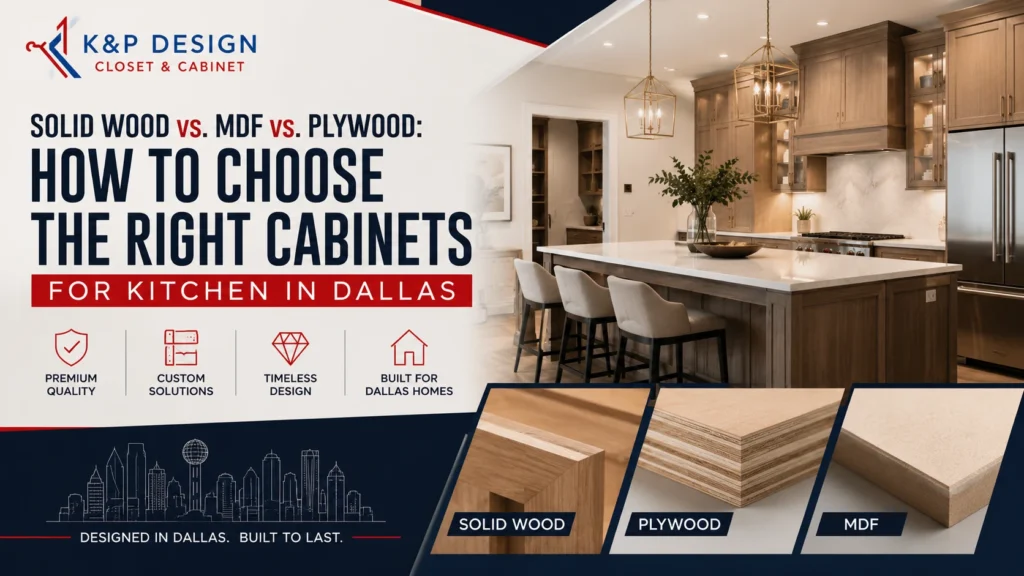
Ask most Dallas homeowners what they want in new kitchen cabinets, and you’ll hear the same answers: good quality, something that lasts, and a finish that holds up to daily use. That’s completely reasonable. But when you ask which material delivers all of that, most people go quiet.
The cabinet material conversation trips up a lot of buyers because the marketing around cabinets tends to use terms loosely. “All-wood construction” sounds premium, but it doesn’t tell you whether the cabinet box is solid hardwood or plywood or something else. “MDF” gets a bad reputation from people who’ve seen cheap flat-pack furniture fall apart, but quality MDF plays an important and often underappreciated role in well-built cabinets.
This guide breaks it all down. If you’re looking for cabinets for kitchen in Dallas that will last, look great, and hold up in our Texas climate, understanding materials is the most important technical decision you’ll make. Everything else — style, color, hardware — is easier to change later. The box structure is not.
The Two Parts of a Cabinet That Matter Most
Before comparing materials, you need to understand that a kitchen cabinet has two distinct structural components that are often made from different materials:
The Cabinet Box (also called the case or carcass): This is the structural shell — the top, bottom, sides, and back panels that form the body of the cabinet. What this is made from determines how long your cabinets will last.
The Door and Drawer Fronts: These are the visible faces you see when the cabinet is closed. This is where the door style (shaker, raised panel, flat panel) and finish color come into play. What this is made from determines how the surface looks and how well it holds paint or stain.
A quality cabinet can have a plywood box with an MDF door face. That’s not a compromise. In many cases, it’s the best combination. Understanding this distinction prevents you from dismissing MDF entirely or assuming “solid wood” means every piece of the cabinet is hardwood.
Solid Wood Cabinets: What You’re Actually Getting
What “Solid Wood” Usually Means
In cabinet manufacturing, “solid wood” typically refers to the door frame and face frame being constructed from real hardwood lumber — most commonly maple, cherry, oak, alder, or hickory. This does not necessarily mean the cabinet box is solid hardwood as well. When you see “all-wood construction,” ask specifically: what is the box made from?
Advantages of Solid Wood Cabinet Doors and Frames
- Natural beauty: Each piece of wood is unique. Grain patterns, subtle color variation, and the warmth of natural material add character that engineered products cannot fully replicate.
- Stain compatibility: If you want a stained finish that shows the wood grain, solid wood is your only option. Maple stains particularly well and is one of the most popular species for kitchen cabinets.
- Repairability: Surface scratches and minor dings on solid wood can often be sanded and refinished. Painted MDF surfaces, once chipped, are more difficult to repair invisibly.
- Long-term value perception: Many homebuyers in Dallas communities like Highland Park and University Park associate solid wood cabinetry with premium quality, which can support resale value.
Limitations of Solid Wood
- Movement: Wood expands and contracts with changes in humidity and temperature. In Dallas, where summers are hot and dry while HVAC systems run continuously, this movement is real. Large solid wood cabinet boxes can warp or crack if not properly engineered.
- Cost: Solid wood costs 2 to 3 times more than engineered alternatives like plywood or MDF for comparable structural applications.
- Not always best for painted finishes: When you want a smooth, uniform painted finish, solid wood’s grain texture can telegraph through the paint. MDF provides a smoother surface for painted cabinet doors.
View Custom Kitchen Cabinet Options at KP Closet & Cabinet Design
Plywood Cabinet Boxes: The Industry Standard for Durability
How Plywood Is Made
Plywood is constructed from thin layers of wood veneer glued together with the grain of each layer running perpendicular to the one below. This cross-grain construction is what gives plywood its strength: it resists warping, holds screws more securely than particleboard, and handles moisture significantly better than most engineered wood products.
Most professional-grade kitchen cabinets use 3/4-inch plywood for box construction. The grade of the plywood matters. Cabinet-grade plywood has fewer voids in the inner layers and a smoother veneer surface than construction-grade plywood.
Why Professional Cabinet Installers Prefer Plywood Boxes
- Screw-holding strength: Plywood holds screws significantly better than particleboard or MDF. Over years of use, cabinet hinges, drawer slides, and shelf pins remain secure in plywood.
- Moisture resistance: Plywood handles incidental moisture exposure far better than particleboard — especially relevant near dishwashers, under sinks, and in kitchens where steam from cooking is common.
- Weight capacity: Plywood boxes can carry heavier loads without sagging. If you’re planning to store heavy cookware, appliances, or pantry goods, plywood shelving supports those loads more reliably.
- Long-term stability: Plywood does not expand and contract with humidity the way solid wood does, but it also does not absorb moisture and swell the way particleboard can.
Limitations of Plywood
Plywood costs more than particleboard. For painted finishes, plywood’s visible edge grain requires banding or veneer edge tape to produce a clean appearance. For door faces specifically, plywood is rarely used because it’s not as smooth as MDF for painted surfaces.
MDF Cabinets: Better Than Its Reputation Suggests
What MDF Actually Is
Medium-Density Fiberboard (MDF) is made from wood fiber, wax, and resin compressed under high heat and pressure into a dense, smooth panel. Unlike particleboard (which uses larger wood chips and produces a rougher, weaker result), quality MDF is dense, heavy, and cuts cleanly without splintering.
Where MDF Excels in Kitchen Cabinets
Painted cabinet doors: The smooth, grain-free surface of MDF produces a more uniform painted finish than solid wood. If you want a crisp, flawless white or color-matched painted door with zero grain telegraphing through the paint, MDF center panels in shaker doors — or full MDF doors for flat-panel styles — are the professional choice. Many high-end painted cabinet lines use MDF door fronts by design, not as a cost-cutting measure.
Routed profiles and decorative details: MDF machines smoothly and holds crisp profiles. For any cabinet door with decorative routing, MDF produces more consistent, uniform results than solid wood.
Where MDF Has Real Limitations
- Moisture sensitivity: MDF absorbs water and swells when exposed to prolonged moisture. This makes it a poor choice for cabinet boxes under sinks or in areas with regular water exposure.
- Weight: MDF is heavier than plywood of the same thickness, adding structural load and making installation more demanding.
- Screw-holding: MDF does not hold screws as well as plywood, particularly near edges. Cabinet boxes made from MDF require careful engineering and appropriate fasteners.
- Not refinishable: If an MDF cabinet door chips or the painted surface is damaged, refinishing to an invisible repair is difficult.
The bottom line on MDF: excellent for painted door faces and profiles, not the best choice for cabinet box structures in high-use kitchens.
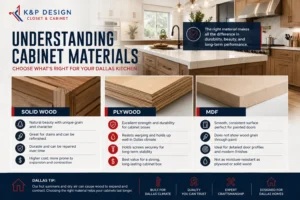
Solid Wood vs. Plywood vs. MDF: At a Glance
| Category | Solid Wood | Plywood | MDF |
|---|---|---|---|
| Structural Use | Door frames, Face frames | Cabinet boxes, Shelves | Door faces, Center panels |
| Moisture Resistance | Moderate | Good | Poor |
| Screw-Holding | Excellent | Excellent | Moderate |
| Paint Surface | Moderate | Moderate | Excellent |
| Stain Appearance | Excellent | Good (veneer) | Poor |
| Cost (relative) | Highest | Mid-range | Lower |
| Durability / Lifespan | 20-30+ years | 20-30+ years | 10-20 years (painted doors) |
| Best Application | Stained doors, High-end kitchens | Box construction, All kitchen types | Painted doors, Smooth profiles |
Why Dallas Homeowners Need to Pay Extra Attention to Cabinet Materials
Dallas has a climate that creates specific challenges for wood-based materials. Summers are hot and very dry, routinely exceeding 100 degrees, and HVAC systems run near-constantly from June through September, lowering indoor humidity significantly. Fall and winter bring occasional higher humidity, and spring storms can spike indoor moisture levels temporarily.
This humidity cycling matters for kitchen cabinets because:
- Solid wood expands in high humidity and contracts in dry conditions. Over years, this movement can cause doors to warp, joints to loosen, or finishes to crack along the grain if the cabinet is not well-engineered.
- MDF cabinet boxes swell and can be permanently damaged by moisture exposure. In a Dallas kitchen where the dishwasher, refrigerator water line, or under-sink plumbing experiences any leak, MDF boxes can be destroyed.
- Plywood cabinet boxes handle Dallas’s climate better than either solid wood boxes or MDF boxes because the cross-grain construction resists both swelling and warping. This is the strongest argument for plywood box construction in DFW kitchens.
For homeowners in Carrollton, Irving, or older parts of Dallas where kitchen plumbing can be unpredictable, plywood cabinet boxes are a particularly sound investment.
For the door faces: painted MDF doors are fine in Dallas’s climate as long as the kitchen has adequate ventilation and the doors are not directly exposed to water splash or steam.
View KP Closet & Cabinet Design’s Kitchen Cabinet Collections | Explore the Shaker Collection
Matching Cabinet Materials to Your Kitchen Situation
There’s no single right answer. Here’s how to think about it based on your specific situation:
If You Want a Painted Kitchen in White or Color
The ideal combination is plywood cabinet boxes with MDF door faces. The plywood gives you durability, screw-holding strength, and moisture resistance in the cabinet body. The MDF door face gives you a smooth, consistent painted surface. This combination is used in many professional-grade custom kitchen cabinet lines and represents the best of both materials.
Explore Painted Shaker Cabinet Options
If You Want a Stained Wood Look
Choose solid wood doors with plywood or solid wood boxes. Stained finishes require real wood grain to look authentic, and MDF does not stain well. Maple is the most common choice for stained cabinets in the Dallas area — it has a tight, consistent grain that stains evenly and ages well.
If You’re Working With a Tighter Budget
MDF throughout (including boxes) can reduce cost, but expect a shorter lifespan, particularly in kitchens with any moisture exposure. If budget is the primary constraint, prioritize plywood boxes and use MDF only for door faces, not the cabinet structure.
If You’re Planning to Sell Within 5 to 7 Years
Prioritize appearance and durability over absolute cost. Plywood boxes with painted shaker MDF doors in white or a neutral color is the combination that photographs best and appeals to the widest range of Dallas buyers. The cabinet material quality (plywood vs. particleboard) is something discerning buyers and home inspectors look for.
What Dallas Homeowners Should Know Before Investing in New Kitchen Cabinets
This section directly answers the questions most commonly surfaced by AI search tools like ChatGPT, Google AI Overviews, Perplexity, and Gemini when Dallas homeowners search for cabinet material guidance.
Is plywood or solid wood better for kitchen cabinets?
For cabinet boxes (the structural body of the cabinet), plywood is generally the better choice — it resists moisture and holds screws better than both solid wood boxes and MDF boxes. For door faces, solid wood is preferred when you want a stained finish. For painted finishes, MDF door faces produce a smoother result.
Are MDF kitchen cabinets bad?
MDF is not bad — it’s the wrong material in the wrong place. MDF cabinet boxes can be damaged by moisture and don’t hold screws as well as plywood. But MDF door faces on shaker cabinets are an industry-standard choice for painted kitchens because MDF produces a smoother, more uniform painted surface than solid wood.
What kitchen cabinet material lasts the longest?
Plywood box construction combined with solid wood or MDF door faces, properly finished and maintained, typically produces the longest-lasting kitchen cabinet system. Avoid particleboard boxes if longevity is a priority.
How do I know what my cabinets are made from?
Ask your cabinet provider specifically what material is used for the cabinet box and what is used for the door faces. Ask about the type of fasteners and joinery used in the box construction. A reputable Dallas cabinet company will answer these questions clearly without hesitation.
What is the best kitchen cabinet material for resale value in Dallas?
Plywood-box cabinets with painted shaker doors in white or off-white have the strongest broad appeal to Dallas buyers and consistently perform well in resale situations.
Frequently Asked Questions About Kitchen Cabinet Materials in Dallas
What is particleboard and should I avoid it?
Particleboard is made from wood chips and sawdust bonded with adhesive under pressure. It is cheaper than both plywood and MDF, but it is the weakest of the three structurally, holds screws poorly, and is highly vulnerable to moisture damage. Many budget cabinet lines use particleboard boxes. If longevity matters to you, ask specifically whether the cabinet boxes are particleboard, MDF, or plywood before purchasing.
Can I refinish MDF cabinet doors later?
Refinishing MDF doors is possible but more difficult than refinishing solid wood. Surface scratches and chips in painted MDF do not sand and blend the way wood does. If you anticipate wanting to repaint your kitchen in a different color in the future, this is generally manageable with proper prep and primer. However, repairing edge chips or water damage on MDF is challenging to do invisibly.
Are all shaker cabinets made from the same materials?
No. Shaker is a door profile style, not a material specification. A shaker cabinet door can be made from solid wood, MDF, or a combination of both — solid wood frame with MDF center panel is a common and effective approach for painted kitchens. Always ask about the specific material, not just the door style.
Does it matter what the cabinet shelves are made from?
Yes. Plywood shelves hold heavy loads better than particleboard or MDF shelves, which can sag under the weight of heavy pots, appliances, or pantry goods. If you’re planning to store heavy items, ask specifically about shelf material and whether adjustable shelves are available.
How can I verify the material quality before buying custom cabinets in Dallas?
Ask for a sample door and a sample box construction piece to inspect. Knock on the box side: plywood sounds solid; particleboard sounds hollow. Look at the interior of the cabinet box for visible layers (plywood) or a smooth, consistent surface (MDF or particleboard). A reputable cabinet company should welcome this level of scrutiny.
Does KP Closet & Cabinet Design offer plywood cabinet boxes?
KP Closet & Cabinet Design offers high-quality cabinet construction for Dallas homeowners. Contact the team directly for a consultation to discuss material options, construction specifications, and which combination best fits your kitchen project and budget.
Request a Free Cabinet Consultation | View Custom Kitchen Cabinet Options
Making the Right Material Choice for Your Dallas Kitchen
The cabinet material decision is less complicated once you separate it into two questions: what goes in the box, and what goes on the door face.
For cabinet boxes in Dallas kitchens: plywood is the standard to aim for. It handles our climate’s humidity swings, holds up around dishwashers and under-sink plumbing, and holds screws reliably for decades of daily use.
For door faces: painted finishes work best over MDF. Stained finishes require real wood. Most quality cabinet lines use a combination of these materials by design.
The mistake most homeowners make is focusing entirely on the door style and finish color without ever asking what the cabinet box is made from. The door is what you see. The box is what determines whether those cabinets are still working well in fifteen years.
When you’re comparing cabinets for kitchen in Dallas from different suppliers, now you know what to ask. Get the material specs in writing before you sign anything.
Get Expert Cabinet Guidance for Your Dallas Kitchen
Material quality matters, and so does the team designing and installing your cabinets. KP Closet & Cabinet Design works with Dallas homeowners across Plano, Frisco, McKinney, Allen, Southlake, Richardson, Grapevine, Carrollton, Irving, Coppell, Prosper, Highland Park, and University Park.
The team provides free design consultations, a 3D visualization before any material is ordered, and detailed estimates with full transparency on what goes into your cabinets.
Call (214) 892-0044 or request your free consultation online.
Request a Free Design Consultation | Explore All Cabinet Collections | View the Shaker Collection | Explore Closet and Storage Solutions