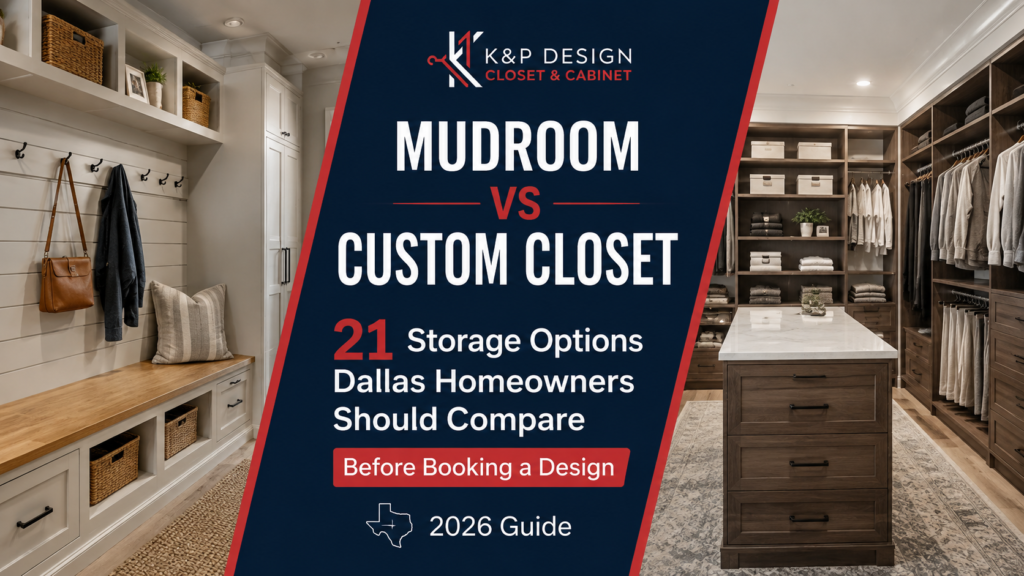
If you typed “mudroom or custom closets” into a search bar before landing here, you’re already ahead of most homeowners planning a storage project. Most people pick one or the other based on which word sounds fancier, not which space actually solves their problem. These two rooms do different jobs, and confusing them is how you end up with a beautiful new closet that still leaves shoes piled by the back door.
A custom closet handles clothing, shoes, and personal items, and it usually lives in a bedroom or a dedicated walk-in space. A mudroom handles everything that walks through your front door or garage entry each day: backpacks, muddy sneakers, dog leashes, sports bags, mail, and whatever else your family drops the second they get home. Some Dallas houses genuinely only need one of these. Many need both, just not at the same time or on the same budget.
Below is a rundown of 21 closet and mudroom setups we build regularly, plus a straightforward way to figure out which one deserves your budget first.
One mistake we see constantly on the design side: homeowners try to force one space to do both jobs. They ask for a mudroom that also holds off-season clothes, or a bedroom closet that somehow needs to catch backpacks and shoes too. It rarely works long term, because the two spaces get used differently and at different times of day. A closet gets opened once or twice a day at a calm pace. A mudroom gets hit hard, twice a day, usually while someone is late for something. Designing for that difference is most of what separates a system that stays organized from one that falls apart within a few months.
This list comes directly from the design and installation crew at K&P Closet & Cabinet Design. We build custom closets and mudroom systems for homeowners in Dallas, Richardson, Addison, and Allen, and everything you’re about to read is pulled from projects we’ve actually measured, designed, and installed in North Texas homes. None of this is copied from a national pricing chart that assumes you live somewhere with a basement.
Mudroom or Custom Closet: What’s A Real Difference:
Here’s the simplest way to think about it. A custom closet organizes what you wear. A mudroom organizes what you carry. Homeowners who install either one tend to report the same thing: less searching, less morning chaos, and a lot fewer items left on the floor because there was never a real spot for them. A mudroom does the same job for coats and shoes that a closet does for your wardrobe, just at the door instead of the bedroom.
If bedroom storage is your main headache, our guide to walk-in closet layouts and pricing in Richardson, TX goes deeper into that specific topic and includes real cost ranges. This article is built to compare the two spaces side by side, so you can decide where your first dollar should go.
21 Storage Options Worth Comparing in 2026
Custom closet options
- Reach-in closet systems. The setup you’ll find in most Dallas bedrooms. A single row of hanging space, shelving, and drawers built into a standard closet opening, no structural changes needed.
- Walk-in closet systems. A room-sized closet with separate hanging zones, shelving, drawers, and often a center island or bench. Check our walk-in closets page if you want to see how these get laid out.
- Wardrobe-style closets. Freestanding cabinet units for homes without a real closet to work with, which shows up a lot in older Dallas houses with smaller bedrooms than modern builds.
- His-and-hers split closets. Two distinct zones inside one walk-in, each built around different hanging heights, shelf depths, and how two different people actually store their stuff.
- Double-hang sections. Two rods stacked one above the other to double up hanging space for shirts, folded pants, and anything shorter than a full-length coat.
- Long-hang sections. One tall rod reserved specifically for dresses, robes, and coats that need the extra drop length.
- Shoe storage closets. Angled shelves, cubbies, or pull-out racks that keep shoes visible and dust-free instead of shoving them into a pile at the bottom of the closet.
- Closet islands with drawers. A center island in a larger walk-in that adds folding space on top and extra drawer storage underneath, useful for anyone tired of folding laundry on the bed.
- Closets with built-in lighting. LED shelf lighting and interior fixtures that make it easier to actually see color and find what you’re looking for, especially helpful in closets with no windows.
- Accessory and jewelry inserts. Velvet-lined drawers, tie racks, and belt hooks so small items stop turning into a tangled mess at the back of a drawer. Our accessories page has more layout ideas.
- Closets with built-in hampers. Pull-out laundry hampers built directly into the closet, which works especially well paired with a nearby laundry room setup.
Mudroom options:
- Locker-style cabinets. Individual cubbies for each family member, often with a door, hook, and bench seat combined. Works well for households with kids who need their own designated spot for backpacks and shoes.
- Open cubby mudrooms. No doors, just open shelving and hooks. Faster to use every single day, though it shows clutter more openly than a closed locker system does.
- Mudroom benches with storage. A seating bench with a lift-top or drawers underneath for shoes, giving you an actual place to sit while pulling on boots instead of balancing on one foot in the hallway.
- Wall-mounted hook systems. Simple rows of hooks for coats, bags, and leashes. A solid, budget-friendly starting point if a full mudroom build isn’t in the cards yet.
- Mudrooms with cabinet storage. Closed cabinets above or below the bench that hide seasonal gear, sports equipment, or pet supplies out of view. Our mudroom design page has more examples of this layout.
- Drop zones with charging stations. A small counter or shelf near the entry with built-in outlets for keys, mail, and phones, so nothing gets lost in the shuffle between the car and the kitchen.
- Boot trays and drainage areas. A dedicated tray or slatted shelf that catches mud and water from shoes before it ever reaches the rest of your floor.
- Pet-friendly mudroom stations. Built-in feeding areas, leash hooks, and a small wash station for dog owners, a request we’re seeing more often in newer Dallas builds.
- Combined mudroom and laundry cabinetry. Storage that flows straight from the mudroom into the laundry room, common in newer North Texas floor plans where those two spaces already sit side by side.
- Garage entry mudroom systems. Built specifically for the door between the garage and the house, which is one of the busiest entry points in most homes. Pairs naturally with a garage storage system if you want the garage itself organized too.
Which One Does Your Dallas Home Really Need:
Start by paying attention to where the mess actually lands over the course of a week. If it’s your bedroom floor and a closet rod packed three coats deep, a custom closet system should be first on your list. If it’s shoes kicked off by the door, backpacks dumped on the kitchen counter, and coats draped over dining chairs, a mudroom is going to fix more of your daily annoyance, faster.
Budget matters here too. Custom closets in the Dallas and Richardson area generally cost more upfront because of the amount of shelving, drawers, and hanging sections packed into one space. Mudrooms, on the other hand, can usually be built in stages. Start with a bench and hooks, then add cabinetry once the budget allows. Our detailed guide to custom closet costs in Richardson, TX walks through real project numbers if you want specifics before a consultation.
Home value is another piece worth considering. Buyers touring a home tend to notice organized storage right away, and a working mudroom near a garage entry is one of the details that stands out during a showing, right alongside a clean kitchen and a finished garage.
Family size and daily routine matter just as much as square footage. A household with kids leaving for school every morning usually gets more day-to-day value from a locker-style mudroom than from an elaborate walk-in closet, simply because the mudroom deals with chaos that repeats twice a day, every day. Empty nesters or homeowners without kids at home often land the other way, where an outdated, cramped bedroom closet is the bigger daily irritation. There’s no single right answer here, only the answer that fits how your household actually moves through the house each morning.
It also helps to think about how long each option takes to build and how disruptive it is. A wall-mounted hook system or a simple bench can go in over a weekend with almost no disruption to the rest of the house. A full walk-in closet remodel or a locker-style mudroom with cabinetry takes longer to design and install, since it usually involves custom millwork built to fit your exact space. Neither is better across the board. If your entryway just needs somewhere for shoes and coats to land, jumping straight to a full custom build is overkill. If your closet has been the same wire shelving since the house was built, a smaller mudroom upgrade won’t fix the actual problem you’re dealing with every morning.
Closet and Mudroom Builds from K&P Design
K&P Closet & Cabinet Design builds custom closets and mudroom systems for homeowners across Dallas, Richardson, Addison, and Allen. Every project starts with a free consultation, either in your home or over the phone, followed by a 3D design and a firm cost estimate before anything goes into production.
We build with American-sourced materials, and most installations wrap up in a day or two depending on the size of the project. If you’re trying to decide between a full closet remodel and smaller upgrades, we’ve also put together a separate guide covering 21 premium closet ideas for Dallas homes that pairs well with this one.
If your storage needs go beyond closets and mudrooms, take a look at our entertainment room storage solutions and custom home office builds as well.
Final Thoughts
Whether your home needs a mudroom, a custom closet, or both, the goal doesn’t change: give every item in your house an actual place to live instead of a pile to join. If you’re ready to stop living out of laundry baskets and shoe piles by the door, schedule a free consultation with K&P Design, and we’ll help you plan a system built around how your household actually lives, not how a showroom photo says it should.
FAQs
Should I build a mudroom or a custom closet first? It comes down to where your clutter actually lives. If your bedroom closet is overflowing and hard to use every day, start there. If shoes, bags, and coats keep piling up near your entryway or garage door, a mudroom will likely clear up more visible clutter, faster. Plenty of Dallas homeowners end up building both eventually, usually starting with whichever space is causing the most frustration right now.
How much does a custom mudroom cost in Dallas? It depends heavily on size and features. A simple hook-and-bench setup sits at the lower end, while a full locker system with cabinetry, a charging station, and built-in storage runs higher. A free in-home consultation with our design team is the fastest way to get an accurate number for your specific entryway.
Can a mudroom and a custom closet share the same space? Sometimes, but it depends on the layout. A large laundry room near a garage entry can often absorb both jobs, with mudroom storage on one wall and closet-style shelving for off-season items on another. A small entryway usually can’t stretch that far without feeling cramped, so we typically recommend keeping the two functions separate unless the room is genuinely large enough to support both without one crowding out the other.