Walk into any kitchen showroom in Dallas and you will hear two words thrown around constantly: custom and stock. Sales reps use them like they are self-explanatory, but most homeowners walking through a remodel for the first time have no real sense of what separates one from the other, or why the price tags can be so far apart for cabinets that sometimes look nearly identical in a catalog photo.
This matters because the choice affects your budget, your timeline, and how well your kitchen actually works once the boxes are hung and the doors are on. Pick the wrong category for your situation and you either overpay for flexibility you did not need or you end up stuck with cabinets that never quite fit your space the way you wanted.
This guide breaks down what stock and custom cabinets really mean, what they cost in Dallas right now, and how to figure out which one makes sense for your kitchen before you sign anything with a cabinet company like KP Closet and Cabinet Design or anyone else in the metro.
Table of Contents
- What Stock Cabinets Actually Are
- What Custom Cabinets Actually Are
- The Middle Ground: Semi-Custom Cabinets
- The Cost Difference in Dallas
- The Timeline Difference
- Quality and Materials: What You Are Really Paying For
- When Stock Cabinets Make Sense
- When Custom Cabinets Are Worth It
- Common Mistakes Dallas Homeowners Make
- How to Decide for Your Kitchen
- Working With a Local Dallas Cabinet Company
- The Bottom Line
- Frequently Asked Questions
What Stock Cabinets Actually Are
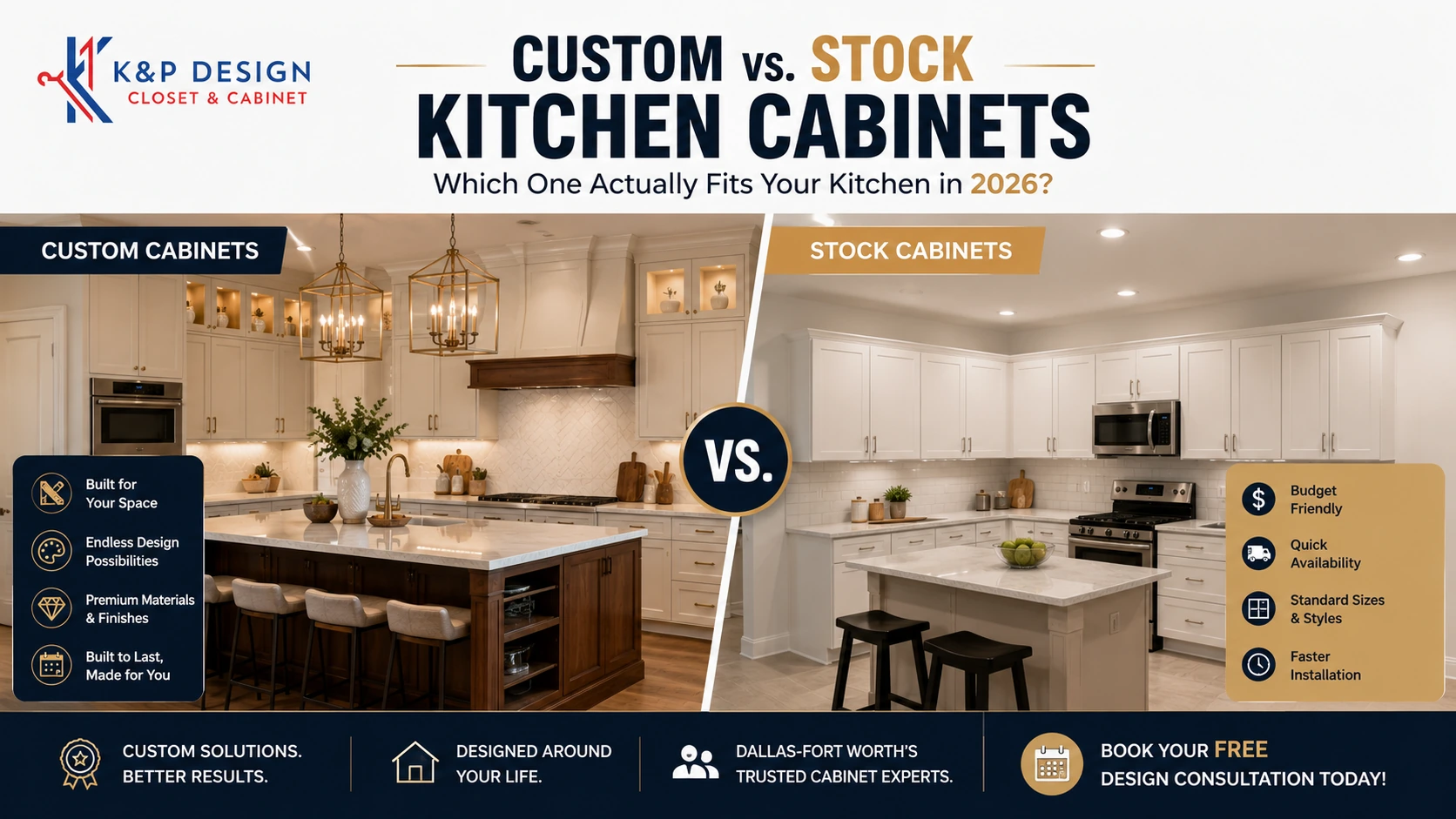
Stock cabinets are pre-built in standard sizes, usually in three-inch increments, and kept in a warehouse ready to ship. Those standard increments follow the same sizing conventions the National Kitchen & Bath Association uses across the industry. A big box store or a cabinet dealer orders from a catalog, and what arrives is exactly what was in the catalog. No custom sizing, no design consultation beyond picking a door style and finish from whatever is available.
The upside is speed and price. Because these cabinets are mass produced in bulk runs, the cost per unit drops significantly, and you can often have them in your kitchen within a few weeks of ordering. For a rental property, a flip, or a straightforward kitchen with standard dimensions, stock cabinets get the job done without a long wait or a big bill.
The tradeoff is fit. If your kitchen has an odd angle, a low ceiling, an unusual appliance gap, or any layout quirk that does not match a standard grid, stock cabinets force you to work around the mismatch with filler strips and awkward gaps. You are fitting your kitchen to the cabinets instead of the other way around.
What Custom Cabinets Actually Are
Custom cabinets are built to order for your exact kitchen. A designer measures your space, discusses how you actually cook and store things, and then a cabinet maker builds boxes, doors, and drawers sized to those specific measurements. Nothing is pulled off a shelf. Every piece is made for your walls, your appliances, and your habits.
This is where you get real flexibility. Want a drawer that is two inches deeper than standard to fit your stand mixer? Done. Need a cabinet that steps around a support column that a standard grid would ignore? A custom shop handles it without blinking. Want a specific wood species, a stain color mixed to match existing trim, or interior organizers built into the design instead of added later? All of that is on the table with custom work. If you want to picture the possibilities before you commit, browsing kitchen design inspiration on Houzz is a useful starting point.
The cost of that flexibility is money and time. Custom cabinets are built one kitchen at a time by skilled tradespeople, not stamped out on an assembly line, so the price per linear foot runs well above stock. You are also waiting on a build schedule instead of pulling boxes off a shelf, which stretches the timeline.
The Middle Ground: Semi-Custom Cabinets
Most Dallas kitchens do not need pure custom and cannot get by on pure stock either, which is why semi-custom cabinets exist and why they are the most common choice for a full kitchen remodel in the area.
Semi-custom starts with a standard base of sizes and styles, similar to stock, but adds a range of modifications. You can usually adjust cabinet width and height within limits, choose from a wider range of door styles and finishes, and add interior features like pull-out shelves, soft-close drawers, and specialty organizers that stock lines simply do not offer.
Think of it as a compromise built for kitchens that are mostly standard with a few spots that need something better. You get meaningfully more flexibility than stock without paying full custom prices or waiting on a full custom build schedule. For a lot of Dallas homeowners, this is the sweet spot.
The Cost Difference in Dallas
Money usually drives this decision more than anything else, so here is where the categories actually land. These ranges line up with Angi’s kitchen cabinet cost data, which tracks remodeling prices nationwide.
Stock cabinets in the Dallas area typically run somewhere between $100 and $300 per linear foot installed, depending on material and finish. For an average kitchen with around 20 linear feet of cabinetry, that puts a stock cabinet job in the $2,000 to $6,000 range before countertops and other finishes.
Semi-custom cabinets usually run $150 to $650 per linear foot, which works out to roughly $12,000 to $25,000 for a full mid-size kitchen once you include installation. This is the range where most complete kitchen remodels in Dallas actually land, because it covers real quality without the top-end custom price.
Full custom cabinetry starts around $500 per linear foot and climbs from there, often reaching $1,000 to $1,200 or more per foot for premium wood species, hand-applied finishes, and complex configurations. On a mid-size kitchen, that can mean a cabinet budget of $25,000 to $40,000 or higher before you factor in anything else in the room.
Keep in mind these numbers shift with wood species, door style, hardware, and how many special features you add, like glass fronts, a built-in wine rack, or a hidden appliance garage. Get a real quote for your specific kitchen before you lock in a budget number in your head.
The Timeline Difference
Stock cabinets move fast. Because they are already built and sitting in a warehouse, you can often have them delivered within one to three weeks of ordering. Installation itself usually takes a few days once the cabinets arrive, so a stock cabinet kitchen can go from decision to finished install in under a month if nothing else in the remodel holds things up.
Semi-custom sits in the middle. Because there are modifications involved, most Dallas suppliers quote four to eight weeks for the cabinets to be built and shipped. Add installation time and you are usually looking at six to ten weeks from order to a finished kitchen.
Custom cabinets take the longest by a wide margin. Because a craftsman is building each piece from scratch, lead times of eight to twelve weeks are common, and complex projects with premium materials can stretch past that. If you are planning around a specific date, like hosting a holiday or closing on a home sale, that lead time needs to be part of your planning from day one, not an afterthought once the project is already underway. If you want a stage-by-stage view, this typical kitchen remodel timeline breaks down where the weeks actually go.
Quality and Materials: What You Are Really Paying For
Price differences are not just about labor and lead time. The materials themselves shift as you move up the categories.
Stock cabinets often use particle board or medium-density fiberboard for the box construction, with a thin veneer or laminate covering the visible surfaces. This keeps costs down, and modern engineered wood products are genuinely more stable than they used to be, but they are more vulnerable to water damage and have a shorter realistic lifespan than solid wood construction, especially in a kitchen with real daily use. If you want a deeper look at how plywood vs. particle board cabinet boxes compare, This Old House lays out the differences clearly.
Semi-custom typically steps up to plywood box construction, which holds up better against moisture and daily wear. Door materials vary more widely here, ranging from engineered wood with a durable finish to solid wood options depending on the line and manufacturer you choose.
Custom cabinets are usually built with solid plywood boxes and solid wood doors and face frames as a baseline, with premium hardwood species like maple, cherry, and white oak available depending on your budget. The construction methods also tend to be stronger, with techniques like dovetail drawer joints and full-extension, soft-close hardware included as standard rather than an upgrade.
None of this means stock cabinets are bad. A well-made stock cabinet from a reputable line will serve a kitchen well for many years. But if you are comparing options and the price gap seems confusing, this is usually where it comes from. You are paying for material quality and construction method as much as you are paying for the custom sizing itself.
When Stock Cabinets Make Sense
Stock cabinets are the right call in a handful of situations that come up often in Dallas.
If you are renovating a rental property, stock cabinets let you refresh the kitchen affordably without sinking custom-level money into a unit you do not live in. If you are flipping a house, the math works the same way. You need the kitchen to look good and function well for a buyer, not to be a forever kitchen built around your specific habits.
If your kitchen has a straightforward, standard layout with no odd angles or unusual appliance gaps, stock cabinets can fit cleanly without the compromises that come up in trickier spaces. And if your budget is tight and the choice is between stock cabinets now or waiting years to save for custom, a good stock line installed well beats an outdated kitchen you are unhappy with every single day.
When Custom Cabinets Are Worth It
Custom makes sense when your kitchen or your goals do not fit inside a standard box.
If you have an unusual layout, whether that is an angled wall, a low soffit, an oddly placed support beam, or appliances in nonstandard spots, custom cabinets solve problems that stock and even semi-custom lines cannot. If you are building or renovating a high-end home and the kitchen needs to match that level of finish throughout, custom construction and premium materials deliver a result that reads as intentional rather than assembled from a catalog.
If you have specific storage needs tied to how you actually live, custom is where you get exactly what you need instead of settling for the closest available option. A baker who needs a pull-out marble slab for rolling dough, a family that wants a built-in appliance garage sized for a specific coffee machine, or a home cook who wants deep drawers instead of standard shelving throughout the entire kitchen are all situations where custom earns its price.
And if you plan to stay in your home long term, custom cabinets amortize that higher upfront cost over many years of use exactly the way you want the kitchen to work, which is a different value calculation than a home you plan to sell in a few years. Industry data like Remodeling Magazine’s Cost vs. Value Report shows kitchen work recovers a meaningful share of its cost at resale, which factors into the long-term math.
Common Mistakes Dallas Homeowners Make When Choosing
A few patterns show up again and again in kitchen remodels across the metro, and knowing them ahead of time can save you real money and frustration.
The first mistake is assuming custom always means better. It does not always mean better for your situation. If your kitchen is standard and your needs are standard, spending custom money buys you flexibility you are not going to use.
The second is going stock on a kitchen with real layout quirks and then being surprised when filler panels and awkward gaps show up during installation. If your contractor mentions filler strips more than once during the walkthrough, that is a sign your space might need at least semi-custom flexibility.
The third is underestimating lead time on custom and semi-custom orders, then panicking when the kitchen is not ready for a planned event. Build in buffer time, especially for custom work, because delays in lumber supply or finish work are common and hard to predict precisely.
The fourth is focusing entirely on the box price and forgetting to budget for countertops, hardware, installation labor, and any electrical or plumbing changes the new layout might require. It also helps to understand your finishes before you buy; a quick primer on choosing the right wood for kitchen cabinets can keep you from over- or under-spending on materials. Cabinets are usually the biggest line item in a kitchen remodel, but they are rarely the only one.
How to Decide for Your Kitchen
Start with your layout. Measure your space or have a designer do it, and be honest about whether it is standard or has quirks that would frustrate a stock installation. Odd angles, low ceilings, and nonstandard appliance placements all push you toward at least semi-custom.
Next, be honest about your budget and your timeline. If you need a finished kitchen in a month, custom is off the table no matter how much you want it. If you have flexibility on both ends, weigh whether the added cost of custom buys you something you will actually use and appreciate for years.
Finally, think about how long you plan to stay in the home. A kitchen you will live with for fifteen years is a different investment than one you are updating before a sale in eighteen months. Match the cabinet category to your actual timeline in the house, not just your dream kitchen in the abstract.
Working With a Local Dallas Cabinet Company
Whatever category you land on, working with a company that offers stock, semi-custom, and full custom options gives you an honest conversation instead of a sales pitch pushed toward whatever they happen to sell. A shop that only carries one line has every incentive to tell you it is the right fit for your kitchen, even when it is not.
KP Closet and Cabinet Design works with Dallas homeowners across all three categories, which means the recommendation you get is based on your kitchen and your budget rather than what happens to be sitting in a warehouse. A good consultation should include a real measurement of your space, an honest look at whether your layout needs custom flexibility, and clear pricing across the options so you can compare them side by side before deciding.
Ask questions during that consultation. Ask what happens if your kitchen has a quirk that stock cannot handle. Ask what the realistic lead time looks like for your specific order, not just a general range. Ask what is included in the quoted price and what counts as an upgrade. The answers will tell you a lot about whether you are working with a company that wants to fit the right cabinets to your kitchen or just sell you whatever is easiest for them.
The Bottom Line
Stock, semi-custom, and custom kitchen cabinets in Dallas are not just different price points. They are different products built for different situations. Stock gets you speed and savings for a standard kitchen or a budget-driven project. Semi-custom covers most full remodels with a solid mix of flexibility and value. Custom solves real layout problems and delivers a kitchen built exactly around how you live, at a price that reflects that level of work.
The right choice depends on your kitchen’s layout, your budget, your timeline, and how long you plan to live with the result. Get honest measurements, get real pricing across all three categories, and choose based on what your kitchen actually needs rather than what sounds impressive. A well-chosen stock kitchen will make you happier than a custom kitchen you stretched to afford and now resent, and a custom kitchen built for a tricky layout will outperform a stock job forced into a space it was never designed for.
Frequently Asked Questions
Are custom kitchen cabinets in Dallas worth the extra cost?
It depends on your kitchen and your plans. Custom cabinets are worth the added cost when your layout has quirks that standard sizing cannot handle, when you have specific storage needs tied to how you cook and live, or when you plan to stay in the home long enough to get real value from cabinets built exactly around your space. For a standard layout with a shorter timeline in the home, semi-custom or stock often delivers similar day-to-day satisfaction for significantly less money.
How much more do custom kitchen cabinets cost compared to stock in Dallas?
Custom cabinets typically run three to five times the cost of stock cabinets per linear foot, with stock landing around $100 to $300 per foot installed and custom starting near $500 and climbing past $1,000 per foot for premium materials and finishes. On an average mid-size kitchen, that can mean the difference between a $4,000 stock cabinet job and a $30,000 or higher custom build, so it is worth getting quotes across categories before deciding which fits your budget.