
KP Design Journal · Dallas / Richardson
How to Design a Kids' Closet That Grows With Your Child: Adjustable Systems for Dallas Families
A kids' closet that grows with your child relies on adjustable shelving, movable hanging rods, and modular storage that can be reconfigured as needs change. Here's how Dallas families can plan one step by step, plus the tradeoffs and…
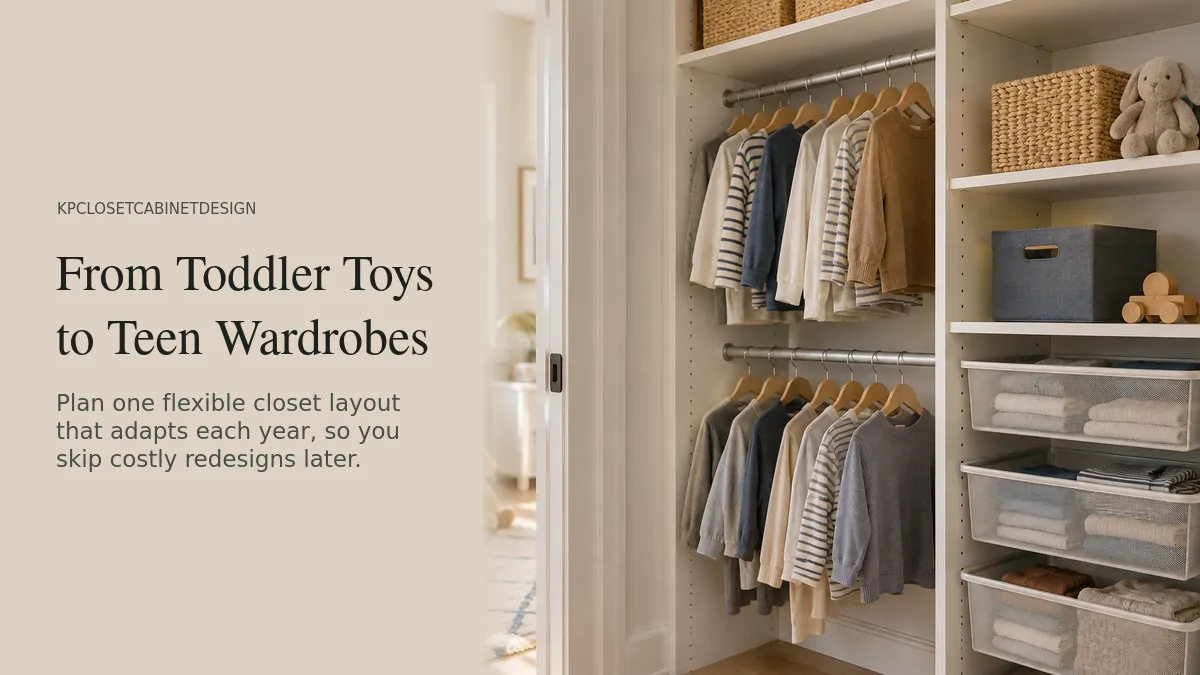
To design a kids' closet that grows with your child, build it around adjustable components: hanging rods you can raise, shelves on movable supports, and modular drawers or bins that can be swapped as storage needs change. Plan the layout for the teenager your child will become, then set it up for the child they are today. A fixed single rod and shelf is easy to install, but it usually fails within a few years, when clothes get longer, toys give way to sports gear, and school supplies pile up. A well-planned custom closets approach avoids repeated tear-outs and keeps everything within reach at every age.
On this page
Why Adjustability Matters More in a Kids' Closet
Adult wardrobes stay fairly consistent. A child's storage needs change in size, type, and reach every few years. Here is roughly how those needs shift. These are general patterns, not fixed rules:
- Toddler and preschool: Clothes are small and short. Diapers, toys, and books take up a lot of space. Kids can't reach high rods.
- Elementary years: Garments get longer. Kids start dressing themselves, and they collect hobby, craft, and sports items.
- Tween and teen years: Clothing is near adult length. Shoes multiply, and there's more need for privacy, accessories, and possibly study supplies.
A closet built for only one of these stages forces you to either live with a poor fit or redo the space. Adjustable closet systems let you keep the same structure and change only the configuration.
The Core Components of a Closet That Grows
Adjustable Hanging Rods
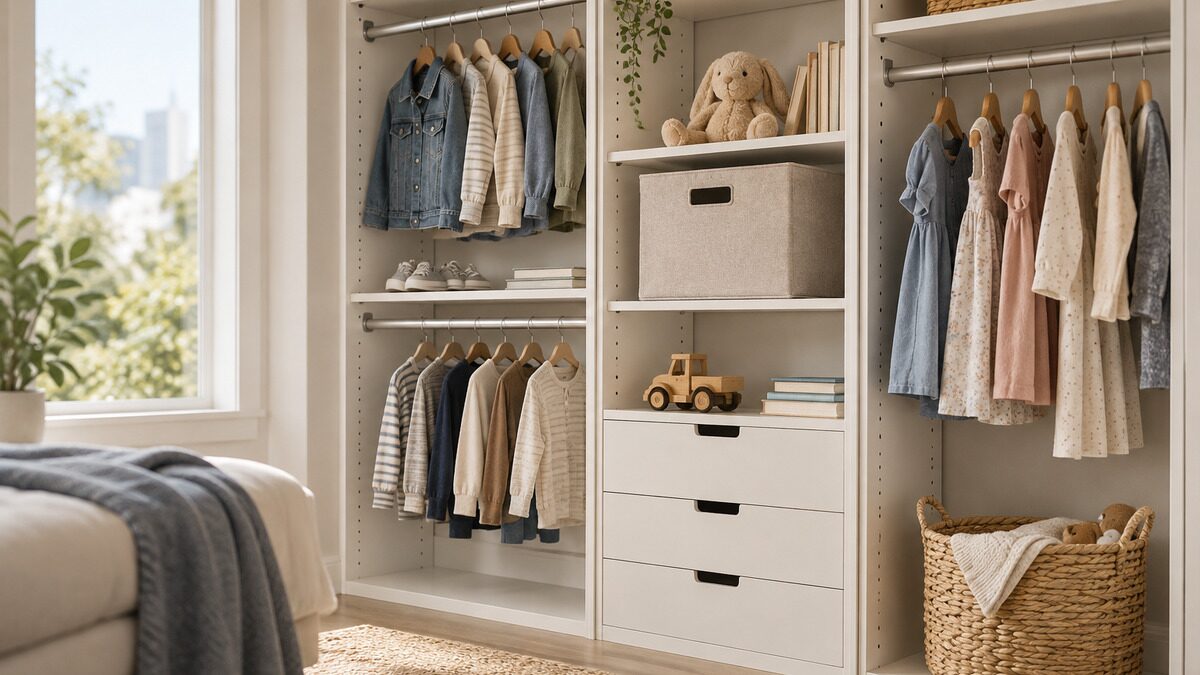
Rods are the most important adjustable element. In the early years, a low rod lets a young child pick out their own clothes. Many families install two stacked rods (double hang) on one wall, because short children's garments fit easily in two tiers. Later, you can remove one rod and raise the other to create long-hang space for dresses, coats, or longer pants.
Decision tip: Choose a system where rods mount to slotted standards or drilled panels rather than fixed wooden cleats. That way, raising a rod takes minutes instead of patching drywall.
Shelves on Movable Supports
Adjustable shelves with shelf pins or track supports let you change spacing as items change. Folded toddler clothes need little vertical space. Teen sweaters, shoe boxes, and storage bins need more. Keep lower shelves for things a child uses daily, and use high shelves for out-of-season items until the child is tall enough to reach them.
Modular Drawers and Bins
Drawers hide clutter and work well for socks, underwear, and pajamas at any age. Open bins are faster for small children to use, since they can toss toys in without opening anything. A practical approach is to start with bins on low shelves and add drawer units later, or choose a system where drawer boxes can be relocated.
Flexible Accessories
Hooks, pull-out baskets, shoe shelves, and valet rods can be added or removed over time. Low hooks for backpacks and jackets help young kids build routines. Higher hooks or a full-length mirror suit older kids better.
Step-by-Step: Planning a Kids' Closet That Adapts
- Measure the space carefully. Record width, depth, ceiling height, and the location of outlets, vents, windows, and the door swing. Standard reach-in closets are often shallow, so every inch matters.
- Inventory what the closet must hold now and later. List current items, then estimate what will be added over the next five to ten years, such as sports equipment, instruments, or formal wear.
- Plan the "end state" first. Sketch how the closet should work for a teenager: long-hang, double-hang, shoe storage, drawers. Make sure the structure supports that layout.
- Configure for today. Set rods low, put bins at kid height, and reserve upper zones for adult-managed storage.
- Choose durable materials. Kids pull on shelves and drawers. Look for sturdy panels, quality drawer slides, and secure wall anchoring.
- Schedule check-ins. Revisit the layout at natural transitions, such as starting school or entering middle school, and adjust rods and shelves rather than rebuilding.
Illustrative Example: One Reach-In Closet, Three Stages
This is a hypothetical scenario for illustration, not a real customer project.
Picture a 6-foot-wide reach-in closet in a Dallas-area bedroom.
- Age 3: The left half has double-hang rods, with the lower rod at a height the child can reach. The right half holds adjustable shelves with fabric bins for toys and a low hook for a backpack. The top shelf stores outgrown clothes and keepsakes.
- Age 9: The lower rod moves up slightly. Two bins are replaced with a drawer unit for folded clothes. A shoe shelf goes in, and one shelf holds sports gear.
- Age 15: The left side becomes long-hang. The right side keeps drawers and adds shelves for shoes and accessories. A mirror and hooks for bags complete the layout.
The walls, panels, and overall structure stay the same throughout. Only the arrangement changes.
Choosing Doors: Swing, Bifold, or Sliding Closet Doors
Doors affect how usable a kids' closet is. Sliding closet doors save floor space in smaller bedrooms because they don't swing into the room, which leaves more room for play areas or a desk. The tradeoff is that you can only open one side at a time, so plan the interior so frequently used items aren't hidden behind a fixed panel. Swing doors give full access and can hold over-door organizers, but they need clearance. Bifold doors fall in between, though young children sometimes find them awkward to operate. Whatever you choose, look for soft-close or pinch-resistant hardware where it's available.
Safety Considerations for Kids' Closets
- Anchor everything. Tall units and drawer stacks should be secured to the wall to reduce tipping risk.
- Avoid climbable layouts. Don't place drawers or shelves so they form an easy "ladder" to heavy upper items.
- Keep heavy items low. Store bulky bins and equipment near the floor.
- Mind the lighting. A closet light helps kids find things on their own. Choose fixtures with no exposed hot bulbs.
Common Mistakes to Avoid
- Designing only for today. Fixed low rods or built-in toy cubbies can become useless in a few years.
- Overloading with open bins. Bins work well early on, but without drawers, older kids' clothes can become a jumbled pile.
- Ignoring depth. Deep shelves in a shallow closet can block rods or make items hard to reach.
- Skipping the upper zone. Space near the ceiling is ideal for seasonal clothing, which matters in North Texas, where wardrobes swing between hot summers and occasional cold snaps.
- Cheap hardware. Flimsy slides and supports wear out quickly under daily use by kids.
Kids' gear often spills beyond the bedroom. Backpacks, shoes, and sports equipment are frequently easier to manage near the entry, and a dedicated mudroom system can take pressure off the bedroom closet.
Frequently Asked Questions
At what age should a child's closet be reconfigured?
There is no fixed schedule. Common trigger points are starting school, a growth spurt that leaves clothes dragging, or a new hobby that brings in equipment. Checking the layout every year or two is a reasonable habit.
Can an existing wire shelf closet be made adjustable?
Often, yes. Some wire systems use track-mounted standards that allow repositioning. Fixed wire shelving usually needs to be replaced with an adjustable track or panel system to get real flexibility.
Should siblings share a closet system?
A shared closet can work if each child has a clearly defined zone with their own rod height, shelves, and labeled bins. Plan the zones so they can adjust independently as each child grows at a different pace.
Is a walk-in closet worth it for a child's room?
If the home already has one, a walk-in offers excellent long-term flexibility, with room for drawers, long-hang, and even a dressing area later. For most kids' rooms, a well-organized reach-in is enough when it uses adjustable components.
Conclusion: Build Once, Adjust Often
The best kids' closet starts with a durable, adjustable structure and a plan for the teen years, then gets configured for your child's current age. Movable rods, repositionable shelves, swappable bins and drawers, and smart door choices let one closet serve a child for many years without repeated remodeling. As a next step, measure your closet, list what it needs to hold now and in the future, and sketch an end-state layout. If you'd like professional help planning an adjustable system for your Dallas home, explore the design services at kpclosetcabinetdesign to start the conversation.