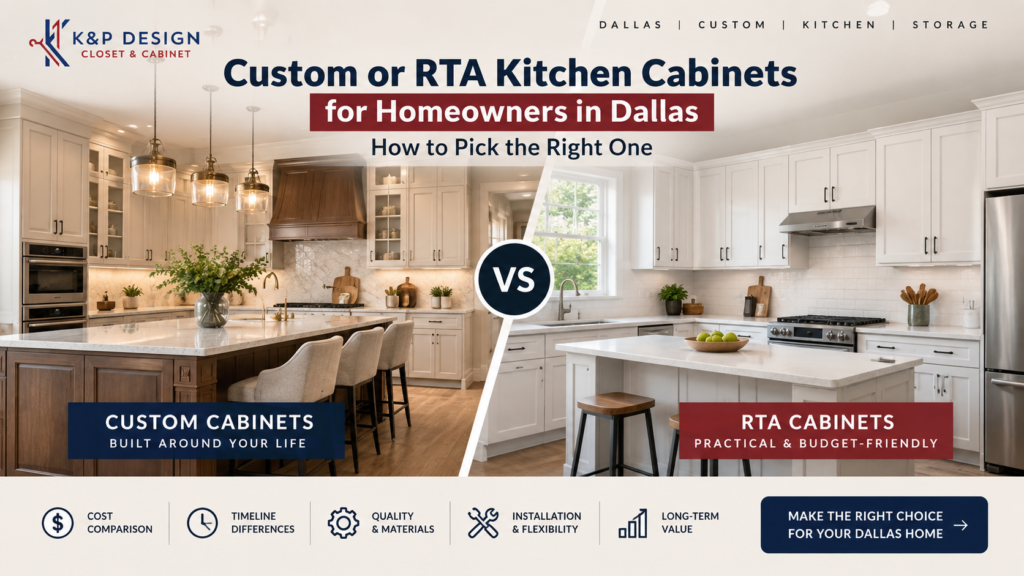
Choosing between custom or RTA kitchen cabinets for homeowners in Dallas usually comes down to budget, timeline, and how standard your kitchen’s layout actually is. RTA (ready-to-assemble) cabinets cost less, often $4,000 to $9,000 for an average kitchen, and ship in one to two weeks, but they come in fixed sizes that don’t always fit older homes. Custom cabinets cost more, usually into five figures, and take six to ten weeks to build, but they’re made to your kitchen’s exact measurements with better materials and joinery. RTA tends to make more sense for standard layouts and tighter budgets, while custom is the stronger fit for unusual layouts, long-term homes, and kitchens where fit and durability matter most. KP Closet & Cabinet Design offers a free consultation to help you decide which one is right for your Dallas kitchen.
Why This Decision Trips Up So Many Dallas Homeowners
A homeowner in Lake Highlands called us last month with two browser tabs open: one for a flat-packed cabinet kit she’d found online, the other for a local custom shop’s quote. The price gap between them was close to $9,000. She wanted to know if that gap was buying her anything real, or if she’d just be paying more for the same box with a nicer invoice.
That question comes up in almost every kitchen consultation we run. RTA, or ready-to-assemble, cabinets have gotten a lot better looking in the last few years, and they show up everywhere from big-box stores to online retailers promising delivery in a week. Custom cabinetry still costs more and takes longer. So which one actually makes sense for your kitchen?
This guide walks through what each option really is, what you’re paying for at each price point, and how to think about the decision for your specific Dallas home, whether that’s a 1980s ranch in Richardson with an odd corner layout or a new build in Frisco with a nine-foot island. For a broader look at cabinet options beyond this one comparison, our complete guide to cabinets for kitchen in Dallas covers styles, materials, and budgeting in more depth.
What RTA Cabinets Actually Are
RTA stands for ready-to-assemble. The cabinet boxes, doors, and hardware arrive flat-packed, and someone, either you, a handyman, or your contractor, puts them together with cam locks, dowels, and screws before they go in the wall.
Most RTA cabinets come in a fixed set of standard sizes: 12-inch, 15-inch, 18-inch base cabinets, and so on, in stock finishes like white shaker or gray shaker. You’re choosing from a catalog, not designing from scratch. That works fine when your kitchen’s dimensions happen to line up with those standard widths. It works less well in older Dallas homes with non-standard bump-outs, low soffits, or a layout that was never quite square to begin with, which describes a fair number of homes built before the 1990s.
What Custom Cabinets Actually Are
Custom cabinets are built to the exact measurements of your kitchen, not the other way around. A designer measures your space, accounts for that out-of-square wall or the plumbing stack that juts out six extra inches, and the cabinets are built to fit it, down to the inch.
This also means you’re not limited to a size chart. Want a 34-inch-wide pantry pull-out because that’s what fits between your fridge and your window? A custom shop can build it. Want a specific wood species, a stain color matched to your existing trim, or soft-close everything as standard rather than an upgrade? All of that is part of the conversation from the start. Our custom kitchen cabinet collections show some of the finish and layout options we build for Dallas kitchens.
Cost: What You’re Really Paying For:
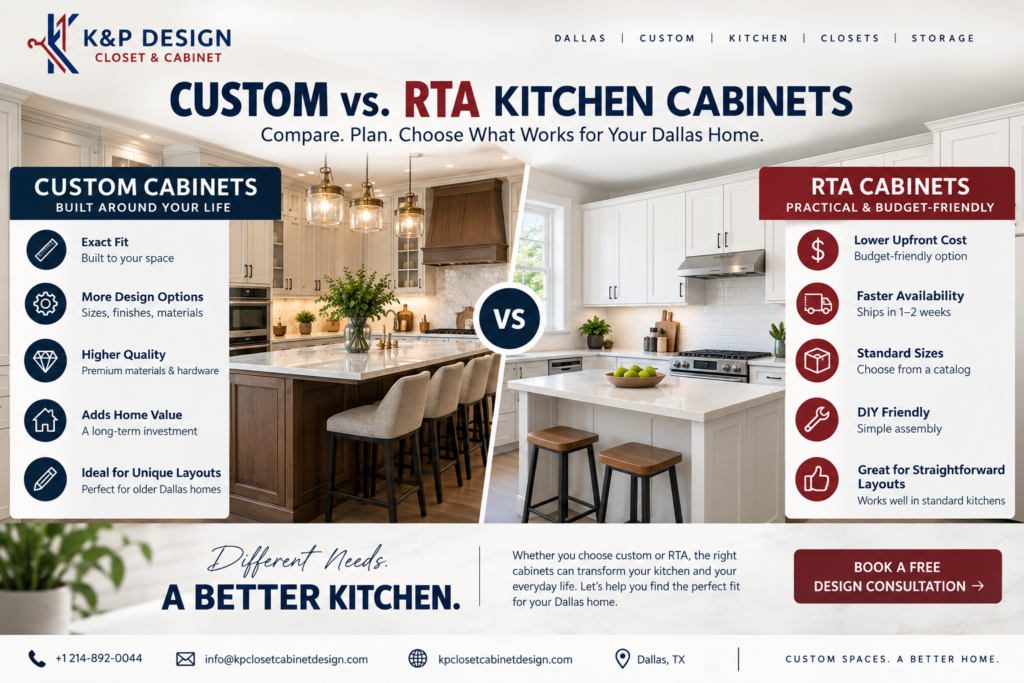
RTA cabinets are the cheaper option almost every time, and it’s not a small gap. Entry-level RTA kitchens for an average Dallas kitchen often land in the $4,000 to $9,000 range for cabinetry alone, depending on the finish and how many linear feet you need. Custom kitchen cabinets for a comparable space typically run higher, often into five figures, because you’re paying for a designer’s time, exact-fit construction, and materials chosen specifically for your kitchen rather than pulled from a standard catalog.
That price difference isn’t padding. It’s covering the labor of custom measuring and building, the flexibility to fix an awkward layout instead of working around it, and, in most cases, better hardware and joinery as a baseline rather than an add-on. Where RTA saves you money upfront, custom cabinets are more likely to save you from a second remodel ten years from now because the layout doesn’t actually fit how you cook.
Timeline: How Long Each Option Takes in Dallas
RTA cabinets win on speed. Many online RTA retailers ship within one to two weeks, and once the boxes arrive, assembly and installation for an average kitchen can be done in a few days if you’re handy or have a contractor lined up.
Custom cabinets take longer because they’re built after your measurements are finalized, not before. Expect a design and measuring phase of one to two weeks, followed by a build time that commonly runs six to ten weeks depending on the shop’s schedule and the complexity of your order. Installation itself, once the cabinets arrive, usually takes one to two days for a standard kitchen.
If you’re working around a hard deadline, like getting a rental turned over or a home listed by a certain date, that timeline gap matters. If you’re planning a full remodel anyway, the extra weeks for custom cabinets often line up with the rest of the project’s timeline without adding real delay.
Materials and Build Quality
This is where the two options diverge the most, and it’s not always visible from a product photo.
Budget RTA cabinets frequently use thinner particleboard or lower-grade plywood for the box, with cam-lock and dowel construction holding panels together instead of glued dovetail joints. Higher-end RTA lines have closed that gap somewhat, using plywood boxes and soft-close hardware as standard. But quality varies a lot between RTA brands, and it’s genuinely hard to tell from a website which tier you’re getting until the boxes arrive.
Custom cabinets built by a local shop are typically constructed from solid plywood boxes with dovetail or mortise-and-tenon joinery, and the shop stands behind the specific materials they used because they built it, not shipped a pre-made kit. According to the National Kitchen and Bath Association, cabinet construction quality is one of the top factors that determines how a kitchen holds up over ten-plus years of daily use, which matters more in a climate like North Texas where humidity swings can stress cheaper particleboard over time.
How Much You Can Actually Change
RTA cabinets give you choices within a catalog: a handful of door styles, a handful of finishes, standard box widths. That’s genuinely enough for a lot of kitchens, especially ones with a fairly standard layout already.
Custom cabinets give you choices outside the catalog. Different cabinet heights to match an unusual ceiling, a corner solution built for the exact angle of your walls, drawer stacks sized around your actual dish set instead of a generic one, appliance garages, built-in spice pull-outs, whatever your kitchen actually needs rather than what happened to be in stock. If your kitchen has any quirks at all, and most Dallas homes built before 2000 do, this is usually where custom starts to earn its price difference.
Assembly and Installation in a Real Dallas Kitchen
RTA assembly is a real project, not a weekend hobby task, even though it’s marketed that way. Every box has to be built square, every door aligned, every drawer glide installed correctly, or you end up with doors that don’t close flush and drawers that stick, problems that show up months later, not on install day. Many Dallas homeowners hire a contractor just for RTA assembly and installation, which narrows the cost gap with custom more than people expect going in.
Custom cabinets arrive pre-assembled and are installed by the same team that measured and built them, which means the person installing your kitchen already knows exactly how it’s supposed to fit. If you’re also planning closet or pantry work alongside your kitchen, our pantry and kitchen storage guidance walks through how those projects often get bundled with cabinet installation for one coordinated timeline.
Resale Value and How Each Option Holds Up
A well-installed RTA kitchen can look great on day one and hold up fine for a normal length of homeownership, especially with a mid-to-upper-tier RTA line. Where it tends to show its age is at the joints and hinges first, cam locks loosening, particleboard swelling slightly at any spot exposed to sink or dishwasher moisture over several years.
Custom cabinets, because they’re built with better joinery and typically better-sealed materials, tend to hold their fit and finish longer, which matters both for daily use and for how the kitchen shows when you eventually sell. Real estate agents in the Dallas market consistently point to kitchen cabinetry as one of the first things buyers notice when walking through a home, and cabinets that still close flush and show no swelling read very differently to a buyer than ones that don’t.
Custom vs. RTA Comparison Table
| Factor | RTA Cabinets | Custom Cabinets |
| Upfront cost | Lower, often $4,000 to $9,000 for an average kitchen | Higher, often into five figures |
| Lead time | 1 to 2 weeks to receive, days to assemble | 1 to 2 weeks design, 6 to 10 weeks to build |
| Fit to your space | Standard sizes, works best in square layouts | Built to your exact measurements |
| Materials | Varies widely by brand, often particleboard at lower tiers | Typically solid plywood with better joinery |
| Customization | Limited to catalog options | Nearly unlimited within the shop’s capabilities |
| Installation | Often requires separate assembly labor | Arrives pre-assembled, installed by the builder |
| Best for | Standard layouts, tighter budgets, faster timelines | Non-standard layouts, long-term homes, full remodels |
Which One Fits Your Kitchen
If your kitchen already has a fairly standard layout, your budget is the main constraint, and you’re comfortable either assembling cabinets yourself or hiring help for that step, RTA is a legitimate option, not just a downgrade. Plenty of Dallas homeowners get a kitchen they’re happy with this way, particularly in newer builds around Prosper, Celina, and parts of Frisco where floor plans already follow standard cabinet dimensions.
If your kitchen has any real quirks, an odd corner, a low soffit, a layout that’s never quite worked for how you cook, or if you’re planning to stay in the home long enough that resale and daily wear both matter, custom cabinets are usually the better investment. That’s especially true in older Dallas neighborhoods like Lake Highlands, Casa View, and parts of Oak Cliff, where original construction rarely lines up with modern standard sizing.
Some homeowners also split the difference: custom cabinetry in the main kitchen run, paired with a simpler RTA solution in a secondary space like a wet bar or laundry room where exact fit matters less. It’s worth discussing both budgets openly with whoever you’re working with rather than assuming it has to be all one or the other.
What Dallas Homeowners Should Know Before Investing in New Cabinets
Before you commit to either option, get exact measurements of your kitchen first, including ceiling height, any out-of-square walls, and appliance clearances. A lot of RTA disappointment traces back to ordering from a size chart that didn’t quite match the actual room.
Ask any cabinet company, RTA or custom, what the box material actually is, not just the door finish. “Plywood box” and “particleboard box with a laminate finish” can look identical in a showroom photo and behave very differently after five years of steam from cooking and moisture from a nearby sink.
Factor in installation labor from the start, not as an afterthought. An RTA quote that looks like a bargain can end up close to a mid-tier custom quote once you add professional assembly and installation, so compare total project cost, not just the cabinet price tag.
Finally, think about how long you plan to stay in the home. A shorter timeline makes the lower upfront cost of RTA more attractive. A kitchen you’ll use daily for the next decade or more tends to justify the extra investment in custom construction, particularly for the primary cook space.
FAQs
Is RTA the same thing as stock cabinets?
Not exactly. Stock cabinets are pre-built and sold as-is, often available same day from a warehouse. RTA cabinets ship flat-packed and require assembly, but both are built to standard, non-custom sizes, which is why they’re often grouped together in comparisons against fully custom work.
Can RTA cabinets work in an older Dallas home?
Sometimes, but it depends on how standard your kitchen’s dimensions are. Homes with square walls and typical ceiling heights can usually accommodate RTA sizing without much trouble. Homes with unusual bump-outs, low soffits, or non-standard corners often need at least some custom filler pieces or custom cabinets to avoid awkward gaps.
How much more do custom cabinets cost compared to RTA?
The gap varies by project, but custom cabinets commonly cost several thousand dollars more than a comparable RTA kitchen once you account for design, materials, and construction. The right comparison is total project cost, including installation labor, rather than the cabinet price alone.
Do RTA cabinets require a professional to install?
Not always, but many homeowners choose to hire one after realizing how much precision assembly actually requires. Doors and drawers that aren’t assembled square tend to misalign within the first year, which is the most common complaint we hear about DIY RTA installs.
Which option adds more value if I plan to sell my home?
Custom cabinets generally hold their fit and finish longer and tend to read as a stronger upgrade to buyers walking through the kitchen, though a clean, well-installed RTA kitchen in good condition can still be a selling point, particularly in a home priced for a first-time buyer.
Final Thoughts
Neither option is automatically the right answer. RTA cabinets make sense for a standard layout, a defined budget, and a homeowner willing to handle or hire out assembly. Custom cabinets make sense for an unusual layout, a longer time horizon in the home, and a kitchen where exact fit and daily durability matter more than the upfront number on the quote.
If you’re still not sure which side of that line your kitchen falls on, that’s exactly what a design consultation is for. KP Closet & Cabinet Design offers a free consultation and 3D design for Dallas homeowners weighing custom against RTA, so you can see actual measurements and options for your kitchen before deciding. Schedule your free design consultation and get a straight answer built around your space, not a generic comparison chart.