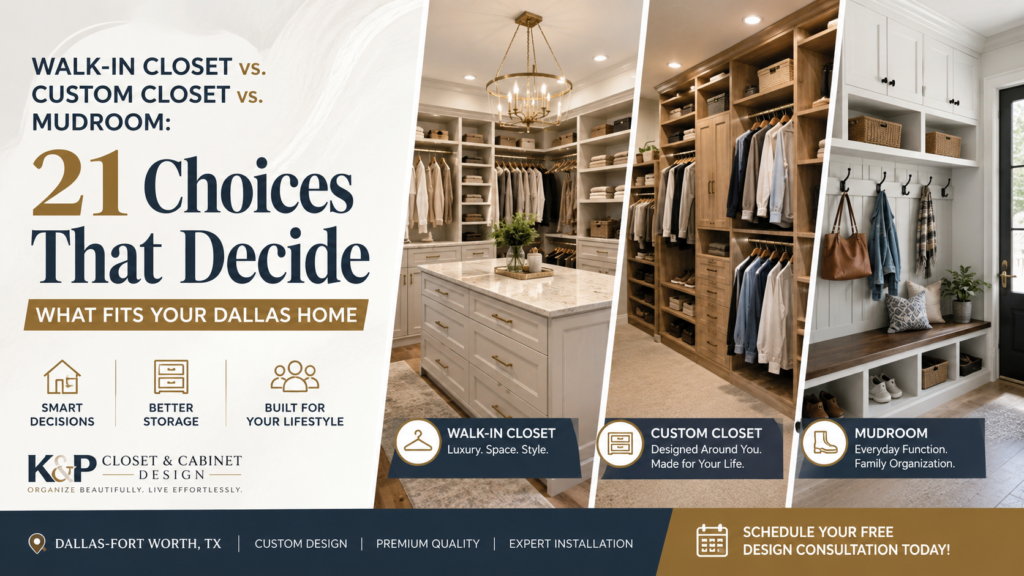
Three Storage Options, One Confusing Decision:
A lot of homeowners come to us saying the same thing: “I know I need more storage, I just don’t know what to actually build.” That confusion usually comes down to three options getting mixed: a walk-in closet, a custom closet system, and a mudroom. They solve different problems, and picking the wrong one for your space wastes both budget and square footage.
This is not a listicle of pretty closet ideas. It is a decision guide built around 21 specific points- cost, space, family size, home layout, and daily routine- that determine which of these three options actually fits your Dallas home. Whether you live in a Highland Park estate, a Frisco new build, or a Richardson townhome, the right answer depends on how you live, not what looks best in a photo.
What Each Option Actually Is:
Before comparing, it helps to define terms, since these three get used loosely.
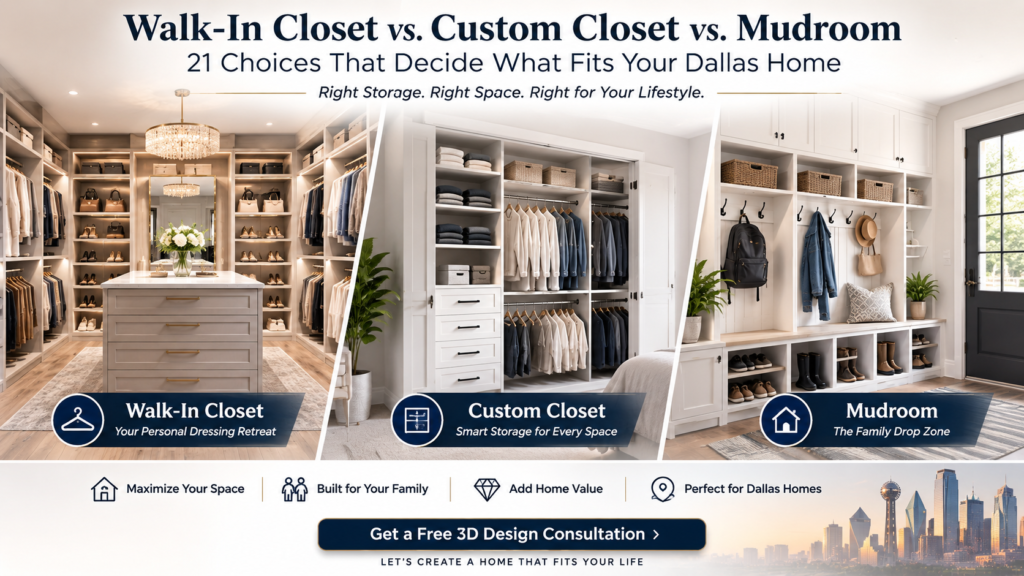
A walk-in closet is a dedicated room, usually off a primary bedroom, that you can physically stand inside. It is built for clothing, shoes, and accessories, and can range from a simple shelving layout to a full boutique-style dressing room with an island.
A custom closet is broader. It refers to any closet, walk-in or reach-in, that is designed around your specific space and belongings rather than built from a generic prefab kit. A custom closet can exist in a primary bedroom, a kid’s room, a hallway, or even a home office.
A mudroom is not a closet in the traditional sense. It is an entry-zone storage system, usually near a garage or back door, built for coats, shoes, backpacks, and the everyday items that would otherwise pile up at your entrance. Mudrooms typically use lockers, cubbies, hooks, and bench seating rather than hanging rods.
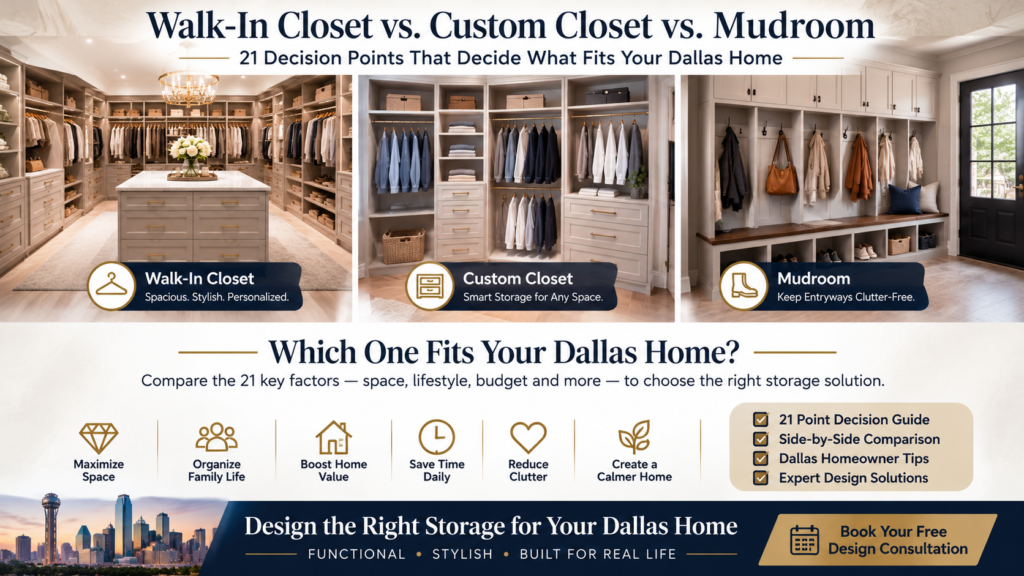
The 21 Decision Points:
Here are the 21 factors that should actually drive your choice between a walk-in closet, a custom closet system, and a mudroom.
Space and Layout
- Available square footage. Walk-in closets need real square footage, generally at least 6 feet of width. Custom reach-in closets fit into much smaller cavities. Mudrooms need width near an entry point, not depth.
- Location in the home. Walk-ins belong in or near bedrooms. Custom closets can go almost anywhere. Mudrooms only make sense near a functional entry, garage door, or back door.
- Ceiling height. Taller ceilings support double-hung rod sections in a walk-in or custom closet. Mudrooms benefit more from vertical cubby stacking than rod height.
- Existing closet cavity. If a closet already exists, a custom retrofit is usually more cost-effective than building new walk-in square footage from scratch.
- Entry traffic flow. A mudroom only works if it sits directly in the path family members use to enter and exit daily. If your garage door does not lead into a logical drop zone, a mudroom loses most of its value.
Household and Lifestyle:
6. Family size. Larger families benefit more from mudroom lockers, since multiple people need separate cubbies. A walk-in closet serves one or two people well.
7. Kids in the home. Mudrooms are one of the highest-impact investments for families with school-age children, since they contain the daily chaos of backpacks and shoes.
8. Wardrobe size. If clothing storage is your real problem, a walk-in or expanded custom closet solves it directly. A mudroom does nothing for wardrobe overflow.
9. Work-from-home needs. Some Dallas homeowners are combining a custom closet with a small desk nook. Mudrooms are not suited for this; closets and spare rooms are.
10. Pet ownership. Mudrooms are increasingly built with a pet washing station or food storage cubby, which neither a walk-in nor a standard custom closet accommodates.
Budget and Timeline:
11. Upfront budget. Custom reach-in closets tend to be the most budget-friendly entry point. Walk-in closets and full mudroom locker systems typically require a larger investment due to size and material volume.
12. Installation time. Most closet and mudroom installations take between half a day and a full day, though larger or more complex builds can take up to two days.
13. Long-term cost per use. A mudroom sees daily use by every household member, often making its cost-per-use lower over time than a closet used by one or two people.
14. Financing needs. Larger projects, like a full boutique walk-in closet or a multi-locker mudroom, are more likely to benefit from financing options than a single reach-in closet upgrade.
Design and Function
15. Style priorities. If you want a design-forward space, boutique-style walk-in closets with two-tone finishes and an island are the current standard. Mudrooms lean more functional, though finishes and hardware still matter.
16. Storage type needed. Hanging storage favors closets. Bulky, irregular items like shoes, bags, and outerwear favor mudroom lockers and open cubby systems.
17. Doors or open storage. Walk-in and custom closets increasingly skip doors in favor of open shelving. Mudrooms often use a mix, open cubbies for daily items, closed lockers for out-of-season gear.
18. Lighting needs. Closets need focused lighting to see clothing and accessories clearly. Mudrooms need durable, bright lighting suited to a high-traffic, often wet or muddy entry zone.
19. Material durability. Mudrooms take more daily wear than closets, since they deal with shoes, bags, and weather. Material choice should reflect that difference in use.
Resale and Long-Term Value
20. Resale impact. A well-designed walk-in closet is one of the more universally appealing upgrades for Dallas home resale, particularly in the primary suite. Mudrooms appeal strongly to family buyers but matter less to buyers without children.
21. Future flexibility. Custom closet systems are the easiest of the three to reconfigure later, since components like shelving and drawers can be moved or resized. Mudroom layouts and walk-in closet footprints are more fixed once built.
Comparison Table: Walk-In vs. Custom Closet vs. Mudroom:
Factor | Walk-In Closet | Custom Closet | Mudroom Typical location | Primary bedroom | Any room | Entry, garage, or back door Space required | High | Low to High | Medium Best for | Wardrobe storage, dressing space | Flexible storage in any room | Daily entry organization Family fit | 1-2 people | Individual or shared | Whole household Budget entry point | Higher | Lower to mid | Mid to higher Resale appeal | High, especially primary suite | Moderate to high | High for family buyers Reconfiguration ease | Moderate | High | Lower
Which One Fits Your Dallas Home?
If your main frustration is a stuffed bedroom closet and you have the square footage, a walk-in closet is usually the right call, especially in Highland Park, University Park, and larger Frisco or Prosper homes where primary suites already have the footprint to support one.
If your challenge is scattered storage across multiple rooms, kids’ closets, a hallway linen closet, a small home office, a custom closet approach lets you tackle each space individually without a major structural project.
If your real problem happens at the front or garage door, shoes everywhere, backpacks on the floor, coats with nowhere to go, a mudroom will solve more daily frustration than either closet option, even if it does not touch your wardrobe storage at all.
Many Dallas homeowners end up doing more than one. A common combination we see across Plano, Allen, and Richardson projects is a custom primary closet paired with a mudroom locker system near the garage entry, solving both the bedroom and entryway problem in a single renovation plan.
What Dallas Homeowners Should Know Before Choosing:
Before you commit to one option, know that custom closets tailored to your storage needs typically run between $2,000 and $6,000, with mudroom locker systems falling in a similar range depending on the number of stations and materials chosen. Installation for most projects takes half a day to a full day, with larger or multi-room builds sometimes running up to two days.
It also helps to walk through your actual daily routine before deciding. Stand at your front or garage door and picture what happens when everyone comes home at once. Then open your bedroom closet and picture your morning routine. Whichever moment causes more friction is usually where your budget should go first.
FAQs:
Q.1: Is a walk-in closet or a custom reach-in closet better for a Dallas home?
Ans: It depends on available space and wardrobe size. A walk-in gives you room to stand inside and view your wardrobe, while a well-organized reach-in can hold nearly as much in a smaller footprint at a lower cost.
- 2: Do I need a mudroom if I already have a coat closet?
Ans: A coat closet handles hanging items, but a mudroom locker system adds individual storage per family member for shoes, bags, and backpacks, which a single coat closet typically cannot manage for a full household.
Q.3: Can I combine a custom closet and a mudroom in one renovation?
Ans: Yes, and it is a common approach for Dallas families. Pairing a primary bedroom closet upgrade with a mudroom near the garage or back entry addresses both wardrobe storage and daily entry clutter in one project.
Q.4: Which option adds the most resale value in Dallas?
Ans: A well-designed walk-in closet in the primary suite tends to have the broadest resale appeal, while a mudroom carries strong appeal specifically with family buyers.
Q.5: How much does a mudroom locker system cost compared to a custom closet?
Ans: Both typically fall in a comparable range depending on size and materials, generally in line with the $2,000 to $6,000 range common for custom closet projects, though the exact cost depends on the number of stations, finishes, and accessories selected.
What is the fastest option to install? Smaller reach-in closets tend to install fastest, often within half a day, while larger walk-in closets or full mudroom systems can take a full day to two days depending on complexity.
Final Thoughts:
Walk-in closet, custom closet, or mudroom, the right answer is not about which one looks best in a magazine. It comes down to the 21 decision points above: your square footage, your family size, your entry layout, and what actually causes friction in your daily routine. Most Dallas homeowners find that mapping their answer to two or three of these factors makes the decision obvious.
Not sure which option fits your home? KP Closet & Cabinet Design offers a free consultation and 3D design to walk through your specific space before you commit to anything. Schedule your free design consultation at https://kpclosetcabinetdesign.com/contact/ and get a clear answer built around your home, not a generic template.