Pick the wrong kitchen cabinets and you will be looking at that mistake every single day for the next 15 to 20 years. This is not a paint color you can redo in a weekend. It is a five-figure decision, bolted to your walls.
That is the pressure behind every kitchen remodel conversation happening across Dallas right now. Homeowners in Highland Park, Plano, Richardson, and Lakewood are staring down the same question: which cabinets actually hold up, look right five years from now, and do not fight with the rest of the house?
2026 has a clearer answer than most years. National data from the Houzz Kitchen Trends Study, combined with what is actually selling in North Texas showrooms, points to twelve specific choices homeowners keep coming back to. Some are about color. Some are about door style. A few are about what is happening inside the cabinet box, where the real cost of cheap construction shows up first.
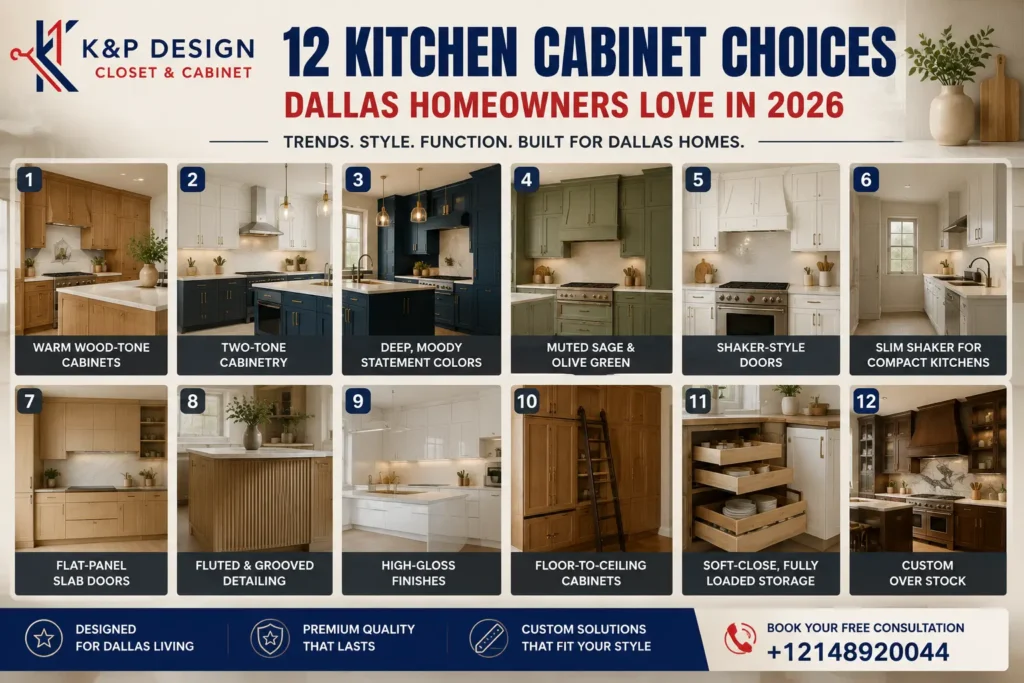
Here is the full list: what each choice looks like, why it is gaining ground, and where it fits, or does not fit, in a Dallas kitchen. If you want to see these applied to real cabinetry, KP Closet & Cabinet Design’s kitchen cabinet collection is a good place to start.
Table of Contents
- Warm Wood-Tone Cabinets Take the Lead
- Two-Tone Cabinetry: Light Up, Bold Down
- Deep, Moody Statement Colors
- Muted Sage and Olive Green
- Shaker-Style Doors: Still the Safe Bet
- Slim Shaker Profiles for Compact Kitchens
- Flat-Panel Slab Doors
- Fluted and Grooved Panel Detailing
- High-Gloss Finishes
- Floor-to-Ceiling Cabinets
- Soft-Close, Fully Loaded Storage Systems
- Custom-Built Cabinetry Over Stock Boxes
- FAQs
1. Warm Wood-Tone Cabinets Take the Lead
For nearly a decade, white cabinets were the default answer. In 2026, that changed. Wood tones now sit at 29% of renovated kitchens nationally, just ahead of white at 28%, the first time wood has out-ranked white in years, and medium wood tones are pulling most of that weight.
The appeal is practical as much as visual. A white kitchen only looks good when everything else in the room is perfect: lighting, hardware, countertop, grout lines. Wood grain has built-in texture and depth, so it forgives a little more and still reads as expensive.
For Dallas specifically, this trend lines up with what is already outside the window. Homes with brick exteriors, limestone accents, and warm-toned flooring tend to look more cohesive with wood cabinetry than with stark white boxes that feel bolted on rather than built in.
2. Two-Tone Cabinetry: Light Up, Bold Down
Two-tone kitchens are not new, but the specific formula gaining traction in 2026 is consistent: lighter uppers, white or off-white leads at 40%, and bolder or darker lowers, wood tones at 37%, followed by blue and green.
There is a functional reason this works, not just a visual one. Lower cabinets take the brunt of daily wear: spills, scuffs from shoe traffic, kids leaning on doors. A darker, richer tone on the bottom hides that wear far better than white ever could, while the lighter uppers keep the kitchen from feeling boxed in.
In Dallas kitchens with strong afternoon light, which is most of them, this contrast also does the room a favor by grounding the space instead of letting it wash out.
3. Deep, Moody Statement Colors
Emerald green, sapphire blue, and oxblood red are showing up on kitchen islands and lower cabinet runs in a way they have not in years. Most homeowners are not painting the whole kitchen this way. It is usually contained to one element, most often the island, so it reads as a design choice rather than a risk.
The reasoning behind this shift: after a decade of all-white, all-gray kitchens, homeowners are willing to add personality back into a room that spends most of the day looking neutral. A deep-colored island next to warm wood or soft white perimeter cabinets creates a focal point without overwhelming the space.
If you are considering this, keep it to one surface: an island, a bar wall, a run of lowers, and let the rest of the kitchen stay quiet. That balance is what separates bold from busy.
4. Muted Sage and Olive Green
Green cabinetry is not the bright, saturated green of a decade ago. What is selling now leans earthy: sage, moss, olive, dusty forest tones with a yellow or gray undertone rather than a cool blue-green.
These shades read as calm rather than trendy, which is exactly why they are holding up across both traditional and contemporary kitchens. A sage green shaker cabinet does not scream 2026 the way a brighter green might have screamed 2015. It has more staying power because it is closer to a neutral than a statement color.
Paired with brass or matte black hardware and a warm wood island, muted green has become one of the more requested non-white, non-wood options in Dallas kitchen consultations this year.
5. Shaker-Style Doors: Still the Safe Bet
Shaker cabinets remain the most common door style in renovated kitchens, 58% by the latest count, and there is no real sign of that changing. The clean, recessed-panel frame works in a 1980s ranch home and a brand-new build in Frisco equally well, which is rare for any design element.
Part of the reason shaker holds up so well is resale. Buyers touring a home do not linger on cabinet doors the way a homeowner does, but a shaker profile reads as updated without reading as trendy, which matters if you are planning to sell within the next five to ten years.
KP Closet & Cabinet Design’s Shaker Collection covers this profile across a range of finishes, from classic white to the wood tones leading 2026’s color numbers.
6. Slim Shaker Profiles for Compact Kitchens
A narrower variation on the classic shaker frame is gaining ground specifically in galley kitchens and smaller layouts. That is a common situation in older Dallas neighborhoods like Lakewood and parts of East Dallas, where kitchens were not built with today’s storage expectations in mind.
The slim shaker profile keeps the clean recessed-panel look but reduces the visual weight of the frame, which matters more than it sounds like it would in a tight space. Wide shaker rails can make a narrow kitchen feel choppy; a slimmer frame keeps sightlines longer and the room feels less closed-in.
The Slim Shaker Collection is worth a look if your kitchen is working with a smaller footprint than you would like.
7. Flat-Panel Slab Doors
Slab doors, flat fronts with no raised or recessed detail, sit at 22% of renovated kitchens, the clear number-two behind shaker. They are the go-to for homeowners chasing a more contemporary, minimal look, especially when paired with wood tones and understated hardware.
Slab doors do require a bit more precision in construction than shaker, since there is no panel detail to hide small inconsistencies in fit and finish. Ask your cabinet provider about this directly. A poorly fit slab door is far more noticeable than a poorly fit shaker door.
8. Fluted and Grooved Panel Detailing
Texture is having a moment, specifically in the form of fluted, vertically grooved, cabinet panels showing up on islands, hutch fronts, and accent sections. Designers have taken to calling this artisan detailing, a term that sounds pricier than what actually shows up on the invoice.
Fluting adds shadow and depth to a cabinet front without adding color or a loud pattern, which makes it a low-risk way to add visual interest to an otherwise simple kitchen. It shows up most often on islands, paired with a plainer shaker or slab perimeter, so the texture reads as a feature rather than a repeated pattern.
9. High-Gloss Finishes
On the opposite end of the texture spectrum, high-gloss lacquer cabinets are holding their own in contemporary Dallas kitchens, particularly open-concept builds where the cabinets need to reflect and bounce natural light around a larger space.
Gloss finishes photograph well and read as modern almost automatically, but they also show fingerprints and water spots more readily than a matte or satin finish, worth knowing before you commit an entire kitchen to it rather than an accent section.
The High Glossy Collection is built specifically for this look, with finishes designed to hold their shine without yellowing over time.
10. Floor-to-Ceiling Cabinets
Storage is being pulled upward. Floor-to-ceiling cabinet runs use wall space that used to sit empty above standard 30-inch uppers, and in Dallas’s larger open-concept kitchens, common in newer builds and many renovated ranch homes, that extra storage means fewer countertop appliances left sitting out.
The visual side effect matters too: a tall, continuous cabinet run gives a kitchen a built-in, finished look rather than a collection of separate boxes stacked at different heights. It is one of the clearest signs of a custom or semi-custom project versus a stock cabinet installation, since stock sizing rarely accounts for a specific ceiling height.
11. Soft-Close, Fully Loaded Storage Systems
Soft-close hinges and drawer slides have moved from a premium add-on to a baseline expectation. Alongside that: pull-out spice racks, tray dividers, built-in trash and recycling drawers, and drawer organizers are showing up in nearly every serious cabinet consultation, not just high-end ones.
This shift matters because it changes what finished means. A kitchen with beautiful doors and disorganized interiors does not feel finished; it feels like the budget ran out before the important part got addressed. Homeowners planning a 2026 remodel are budgeting for the inside of the box as seriously as the outside.
12. Custom-Built Cabinetry Over Stock Boxes
The last choice is not a style, it is a construction decision, and it is arguably the one with the biggest long-term impact. Stock cabinets come in fixed sizes and a limited finish range. Semi-custom allows some adjustment. Fully custom is built to your exact wall dimensions, ceiling height, and layout quirks, with no compromises around a doorway or an oddly placed window. See how these approaches compare in our guide to custom vs stock kitchen cabinets in Dallas.
Texas humidity swings between spring and summer put real stress on lower-quality materials, and the difference between a stock box and a well-built custom cabinet shows up faster than most homeowners expect. Warping, sticking doors, and finish breakdown are almost always a materials problem, not a style problem.
KP Closet & Cabinet Design builds custom kitchen cabinets from American-sourced materials suited to Dallas conditions, with a free consultation and a 3D model of your kitchen before anything goes into production, so you know exactly what you are getting before you commit.
Where This Leaves Your Kitchen
None of these twelve choices require picking every trend at once, that is how a kitchen ends up looking like a showroom instead of a home. The stronger approach is picking two or three that actually fit your layout, your light, and how you use the space day to day, then building the rest of the kitchen around those decisions.
If you are weighing wood tones against a two-tone build, or trying to figure out whether your galley kitchen can handle a bolder color, a short conversation with a cabinet designer will save you more time than another hour of scrolling inspiration photos. Book a free consultation with KP Closet & Cabinet Design and see how these choices translate into your actual kitchen, not just a photo of someone else’s.
For a deeper look at door styles specifically, see our related guide on the best kitchen cabinet styles for Dallas homes in 2026.
FAQs
What’s the single most popular kitchen cabinet choice for Dallas homeowners this year?
Medium-toned wood cabinets are leading nationally in 2026, and that trend holds in Dallas, where wood tones tend to complement the brick and limestone common in the area. Warm off-white and two-tone combinations are close behind.
Can I mix two different cabinet colors, or does that look busy?
Two-tone kitchens are one of the most requested layouts right now, and done correctly, they do not look busy, they look intentional. The formula that works best is a lighter tone on the upper cabinets and a bolder or darker tone on the lowers, which grounds the room instead of splitting it visually.
Are dark or bold-colored cabinets a good fit for a smaller Dallas kitchen?
Yes, if they are used selectively. Committing an entire small kitchen to a dark, bold color can feel heavy. Using that color on a single island or one wall of lowers, with lighter cabinets elsewhere, gets you the visual impact without making the room feel smaller than it is.
What hardware finish works best with 2026 cabinet colors?
Aged brass, matte black, and brushed bronze are pairing well with this year’s warmer wood tones and muted colors. Polished chrome, which dominated the previous decade, is showing up far less often in current kitchen designs.
How much should I budget for new kitchen cabinets in Dallas?
Cost depends heavily on whether you choose stock, semi-custom, or fully custom cabinetry, along with kitchen size and material selection. A free, in-home or phone consultation is the most accurate way to get a number specific to your layout rather than a national average that may not reflect Dallas pricing or your kitchen’s dimensions.
How soon should I schedule my cabinet consultation before starting a remodel?
Earlier than most homeowners expect. Custom cabinetry typically requires 8 to 14 weeks of production lead time, and that window tends to stretch further during Dallas’s busier renovation season in spring. Booking a consultation a few months ahead of your target start date keeps your project on schedule instead of competing with a backlog of other renovations.