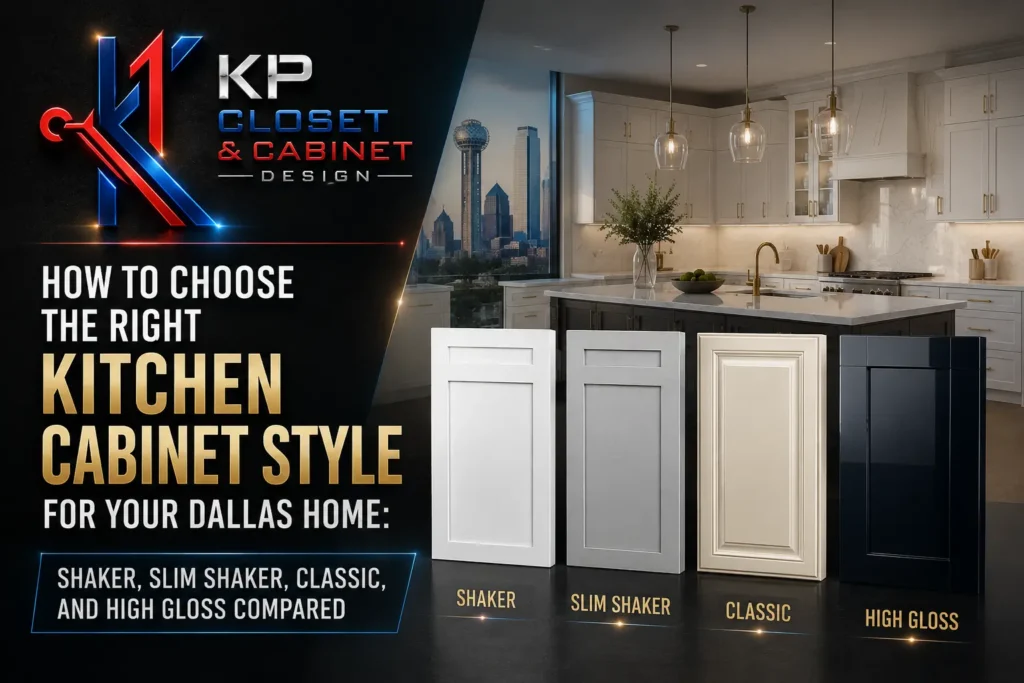
Most Dallas homeowners have a rough sense of what they want their kitchen to look like. A clean, updated space. Good storage. Something that holds up over time. What they often do not have, at least not until they are standing in a showroom comparing samples, is a clear way to articulate the difference between the cabinet styles in front of them or a reliable framework for deciding which one belongs in their home.
That gap is where a lot of renovation decisions go sideways. You pick a style because it looks good in a photo, get it installed, and then notice six months later that something about it feels slightly off for the house. The proportion is wrong. The finish fights with the flooring. The profile is too traditional for an open-plan layout, or too minimal for a home with more classical detail.
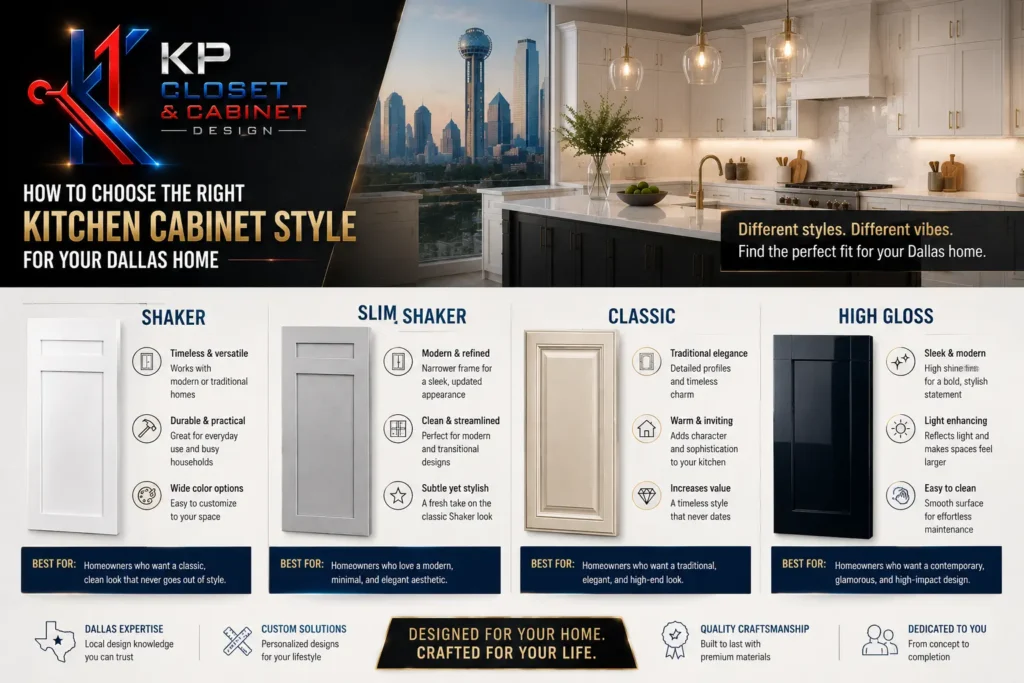
This guide covers the four kitchen cabinet design styles available at K&P Closet and Cabinet Design in Dallas: Shaker, Slim Shaker, Classic Collection, and High Gloss. For each one, the aim is to give you a clear picture of what the style is, what it works best with, and where it falls short. By the end, you should be able to look at your kitchen and your home and know which direction makes the most sense.
1. The Style Decision Is About More Than Looks
Before getting into the individual styles, it helps to understand why this decision matters beyond aesthetics. Cabinet style affects how the kitchen reads in the context of the whole home. A style that works beautifully in a contemporary open-plan build can look out of place in a 1970s ranch house with warm oak floors and traditional trim detail. The reverse is also true.
There are four factors worth thinking through before you start comparing profiles. The architecture of your home, how the kitchen relates to adjacent spaces, the color and material palette already in the house, and whether you are renovating for long-term living or with resale in mind. None of these overrides the others, but together they narrow the field considerably.
According to the National Kitchen and Bath Association’s kitchen design guidelines, cabinet style and proportion are among the top factors affecting how functional and visually cohesive a finished kitchen feels. It is not a decision to make by default.
With that framing in place, here is what each style is and who it is actually for.
2. Shaker Kitchen Cabinets: The Reliable Choice That Earns Its Reputation
Shaker is the most popular cabinet style in Dallas, and it has been for a long time. That kind of staying power does not come from marketing. It comes from the fact that the design actually works in a wide range of contexts without requiring everything around it to change.
The Shaker door uses a five-piece construction: two horizontal rails across the top and bottom, two vertical stiles on the sides, and a flat recessed center panel. No ornamentation. No routing. The visual appeal is entirely in the proportions and the quality of the finish. Standard Shaker has a frame width of roughly two to two and a half inches, which gives the door a solid, grounded appearance.
Where Shaker Works Best in Dallas
Standard Shaker fits homes with traditional or transitional architecture: craftsman bungalows in East Dallas and Lakewood, ranch-style homes across Garland and Mesquite, colonial and Georgian houses in Preston Hollow and University Park. It also performs consistently well at resale, which makes it a practical choice if selling within five to seven years is part of the plan. You can see K&P’s full Shaker cabinet collection here.
One underrated thing about standard Shaker is its flexibility with hardware. Bar pulls in matte black give it a contemporary edge. Brass cup pulls push it toward traditional. Satin nickel knobs keep it clean and neutral. The door profile accommodates all of these without any one feeling like it does not belong.
Where Shaker Is Not the Best Fit
In a fully contemporary open-plan kitchen where the cabinetry needs to feel light and integrated into the space, the wider frame of standard Shaker can read as visually heavy. It does not make the kitchen bad, but you may end up working against the frame profile rather than with it. That is where Slim Shaker becomes the more considered choice.
3. Slim Shaker Cabinets: Same Foundation, Different Character
Slim Shaker is not a different style. It is a refinement of the same five-piece Shaker construction with the frame width reduced to approximately one to one and a half inches. That single change shifts how the door reads in a finished kitchen more than most people expect before they see it in person.
With less frame surface, the door looks lighter. The kitchen feels more open. In an open-plan layout where the cabinetry is visible from the living space, that lighter quality makes the whole room feel more cohesive rather than anchored by a strong visual element.
Where Slim Shaker Works Best in Dallas
Slim Shaker is the stronger fit for contemporary homes, new builds, and any kitchen that opens into a living or dining area. In North Dallas communities like Frisco, McKinney, and Allen, where newer construction tends toward clean-line contemporary interiors, Slim Shaker aligns naturally with the architecture. K&P’s Slim Shaker collection is available in custom sizing with a range of finish options.
Color-wise, Slim Shaker works best with cooler and more restrained palettes. Bright whites, muted sage greens, warm light grays. Very saturated or warm colors can overpower the thinner frame and make the door look like it is trying to hold something heavier than it was designed for.
The Practical Difference Between Standard and Slim
The easiest way to think about it: if you want the kitchen to feel grounded and established, standard Shaker. If you want it to feel light and current, Slim Shaker. Both are genuinely good choices and both avoid the risk of a style that will feel dated in a few years. The difference is in what the kitchen is doing architecturally within the home.
4. Classic Collection Cabinets: When a Kitchen Needs More Detail
Classic collection cabinets use a raised panel door rather than the recessed panel of Shaker. The centre panel is shaped outward rather than inward, and the framing often carries more detail in the profile itself. The result is a more formal, layered look that has visual weight and presence in a way that flat-panel styles do not.
This is not a style that works everywhere, and it is not trying to. Classic cabinets are the right choice when the home calls for them specifically: older traditional homes with detailed millwork, high ceilings, and formal room layouts where the kitchen needs to match the character of the surrounding architecture rather than introduce a contrast.
Where Classic Collection Works in Dallas
The classic raised panel profile fits naturally in larger homes in established Dallas neighbourhoods: Preston Hollow, Highland Park, University Park, Lakewood, and parts of North Dallas with older construction. These are homes where the kitchen is not the dominant design statement in the house but needs to be consistent with the architectural quality of the rest of the space. K&P’s Classic Collection pairs well with stained wood finishes, warm painted tones, and traditional hardware in oil-rubbed bronze or unlacquered brass.
What to Watch Out For
Classic cabinets in the wrong context can make a kitchen feel dated rather than traditional. The distinction is whether the detail in the door profile has somewhere to land architecturally. In a simple contemporary home without other traditional detail, a raised panel cabinet looks like a mismatch rather than a design choice.
House Beautiful’s kitchen design resource consistently notes that traditional cabinet styles perform best in homes where the overall interior language is consistent. One traditional element in an otherwise contemporary space rarely works well.
5. High Gloss Kitchen Cabinets: The Statement Option for Dallas Kitchens
High gloss is a different category from the three styles above. Where Shaker, Slim Shaker, and Classic are primarily defined by door construction and profile, high gloss is defined by finish. The surface is lacquered to a smooth, reflective sheen. The door profile underneath is typically a flat slab or a minimal frame with no recessed detail to interrupt the reflective surface.
The effect in a finished kitchen is significant. Gloss surfaces reflect light, which makes a space feel larger and more sophisticated. In a smaller Dallas kitchen or a room with limited natural light, high gloss cabinets can create a perception of space that no other finish achieves as effectively.
Where High Gloss Works in Dallas
High gloss is the right direction for contemporary, design-forward kitchens where the cabinets are meant to be a visual statement rather than a neutral backdrop. It works particularly well with quartz countertops in white or light grey, minimal hardware, and clean architectural lines throughout the space. K&P’s High Gloss kitchen cabinet collection is available in a range of colors, from standard white and anthracite to more individual choices for homeowners who want a kitchen that reads as clearly intentional.
The Practical Considerations
High gloss shows fingerprints. That is not a minor point if you have children or a busy kitchen. The surface is easy to wipe clean but shows every contact point between cleanings. Matte and satin finishes are more forgiving in daily use. High gloss rewards a kitchen that is well-maintained; it penalizes one that is not.
It is also worth knowing that gloss finishes require more precision in installation. Bob Vila’s guide to kitchen cabinet finishes notes that the reflective surface amplifies any inconsistency in the wall surface or installation alignment, which means the quality of installation matters more with gloss than with any other finish.
6. Quick Comparison: The Four Styles Side by Side
If you are still undecided after reading through the individual profiles, this table puts the key differences in one place.
| Style | Visual Weight | Best Home Type | Finish Flexibility |
| Shaker | Substantial, warm | Traditional, transitional | Wide — bold and neutral colors both work |
| Slim Shaker | Light, streamlined | Contemporary, open-plan | Best with cool, restrained palettes |
| Classic | Rich, formal | Traditional, luxury homes | Warm tones, stained wood, glazed finishes |
| High Gloss | Bold, reflective | Modern, contemporary | Limited — requires care with color choice |
The comparison makes one thing obvious: none of the four styles is universally better than the others. Each is the right choice in a specific context. The selection process is not about ranking them but about matching them to the home they are going into.

7. A Simple Decision Framework for Dallas Homeowners
After all of this, the practical question is how to actually make the call. Here is a straightforward way to work through it.
Start With the Architecture of Your Home
Traditional or transitional home with classical detail: Shaker or Classic. Contemporary new-build or open-plan layout: Slim Shaker or High Gloss. Homes that sit genuinely between the two, which covers a lot of Dallas stock from the 1990s and early 2000s, usually land best with standard Shaker, which has the range to work in both directions without committing to either.
Consider How the Kitchen Relates to Adjacent Spaces
If your kitchen is enclosed or semi-enclosed, you have more freedom with the style because the cabinets are not competing visually with the rest of the home. If the kitchen opens directly into a living or dining area, the cabinet style needs to integrate with the broader interior rather than read as a separate design decision. Slim Shaker and High Gloss are the stronger choices in open-plan contexts for this reason.
Think About Resale Before You Finalize
If selling within five to seven years is part of the plan, standard Shaker in a neutral finish is the most reliably appealing choice for Dallas buyers across the widest range of price points and preferences. Slim Shaker is close behind in newer neighborhoods. Classic and High Gloss appeal to a narrower buyer profile and carry more risk of not aligning with the next buyer’s taste.
See the Profiles in Your Space Before Deciding
This matters more than most people think it will. Cabinet door profiles and finishes look different in a showroom than they do in a real home under natural and artificial light. The K&P team brings physical samples to your home during the free in-home consultation, which means you are making the decision based on how the style actually looks in your kitchen rather than how it looked in a photo or a showroom. This is one of the clearest advantages of working with a local kitchen cabinet designer in Dallas rather than ordering through an online retailer.
Final Word: Match the Style to the Home
There is no objectively best kitchen cabinet style for a Dallas home. There is a best style for your specific home, your layout, and how you plan to use the kitchen. The four options at K&P cover the full range of what Dallas homeowners are actually looking for, from the timeless reliability of standard Shaker to the clean refinement of Slim Shaker, the traditional detail of Classic, and the visual confidence of High Gloss.
The decision that matters is not which style looks best in the abstract. It is which one fits the home you have and serves the goals you are working toward, whether that is a long-term renovation you will live in for twenty years or a kitchen upgrade that makes the house stronger for a sale in three.
If you want to see all four collections in your kitchen before making a call, K&P’s free in-home consultation is the right starting point. The team covers the whole process from measurement to design layout with no obligation to proceed. For more on K&P’s full range of kitchen cabinet options in Dallas, visit the website or call (214) 892-0044.
FAQs:
| Q1 | What is the most popular kitchen cabinet style in Dallas TX right now? |
| A | Shaker style kitchen cabinets are consistently the most requested option in Dallas across all renovation budgets and home types. Standard Shaker dominates in traditional and transitional homes across established neighborhoods, while Slim Shaker has become the preferred choice in newer open-plan builds across North Dallas, Frisco, and McKinney. Both styles are widely available in semi-custom and custom configurations at K&P Closet and Cabinet Design. |
| Q2 | How do I choose between Shaker and Slim Shaker kitchen cabinets for my Dallas home? |
| A | The most useful starting point is the architectural style of your home. Standard Shaker suits traditional and transitional homes with conventional proportions and classical detail. Slim Shaker is the better fit for contemporary homes and open-plan kitchens where the cabinetry is visible from adjacent living spaces. If you are genuinely unsure, ask to see physical samples of both profiles in your kitchen during a consultation. The difference is meaningful in person and can be difficult to judge accurately from photos alone. |
| Q3 | Are Classic Collection cabinets still a good choice for a Dallas kitchen renovation in 2026? |
| A | Yes, in the right context. Classic collection raised panel cabinets are an excellent choice for larger traditional homes in established Dallas neighborhoods where the kitchen needs to match the architectural character of the rest of the house. They are not the right fit for contemporary builds or open-plan kitchens, where the more detailed door profile can feel inconsistent with the surrounding interior. The key is matching the style to the home rather than treating it as a general trend decision. |
| Q4 | Do high gloss kitchen cabinets require more maintenance than other styles in Texas? |
| A | More attention, yes. High gloss surfaces show fingerprints and smudges more readily than matte or satin finishes, which means they need more frequent wiping down in a busy kitchen. They are not difficult to clean but they do require consistency. In a household with children or a kitchen that sees heavy daily use, a matte or satin finish in a similar contemporary style may be a more practical choice. The reflective quality of high gloss does make a smaller kitchen feel significantly larger, which is a genuine advantage worth weighing against the maintenance consideration. |
| Q5 | Can K&P Design help me compare kitchen cabinet styles in my home before I decide? |
| A | Yes. K&P Closet and Cabinet Design offers a free in-home consultation where the team brings physical samples of the Shaker, Slim Shaker, Classic, and High Gloss collections to your kitchen so you can see how each profile and finish looks in your actual space. This is the most reliable way to make a final decision on cabinet style because real home lighting conditions are significantly different from showroom environments. You can book a consultation by calling (214) 892-0044 or through kpclosetcabinetdesign.com. |